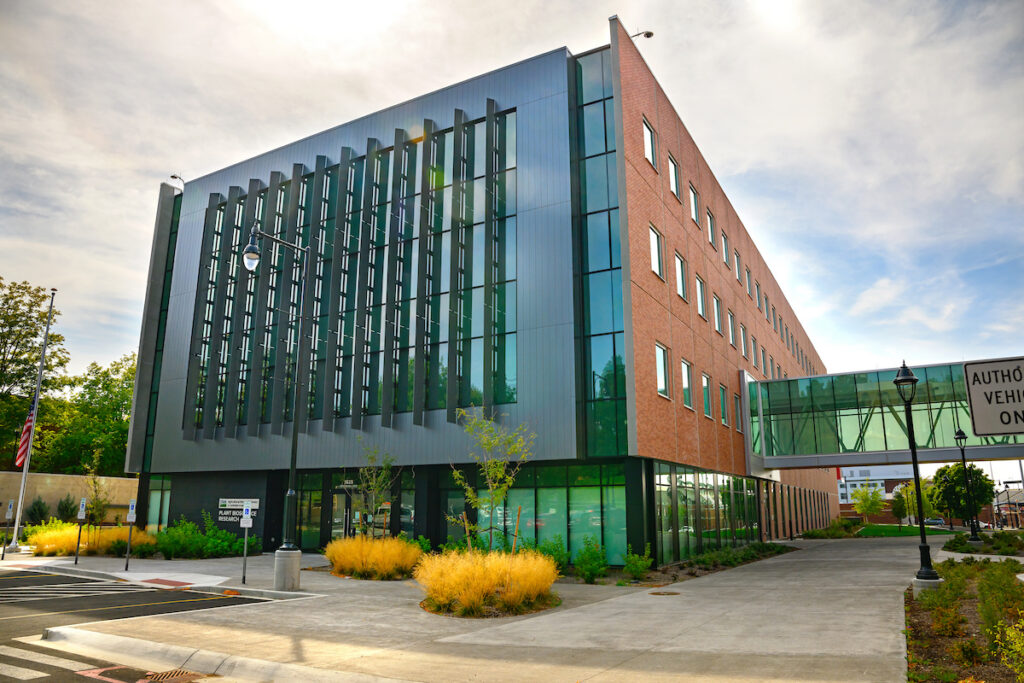
PULLMAN, Wash. — A nearly 100-year collaboration has culminated in a new building that could lead to improved foods for people across the country and the world.
The U.S. Department of Agriculture’s (USDA) Agricultural Research Service (ARS) and Washington State University are opening the USDA-ARS Plant Bioscience Research Building on the WSU Pullman campus, with an official ribbon cutting on Oct. 14.
“This new Plant Bioscience Research Building opens a new chapter in the nearly century-long partnership between ARS and WSU. By bringing federal and university researchers together under one roof, we are accelerating the discoveries and innovations that U.S. farmers, ranchers, and producers need to thrive. This facility reflects our shared commitment to advancing plant and soil science in ways that strengthen the agricultural prosperity of Washington state, the Northwest region, and ultimately American agriculture for generations to come,” said ARS Administrator Joon Park.
The WSU-ARS relationship dates back to 1931 and the famed USDA scientist, and WSU alum Orville Vogel.
“Vogel was an architect of the green revolution that led to huge food production gains for the world,” said David Weller, a research leader in the ARS Wheat Health, Genetics, and Quality Research Unit. “This new building is part of a through line from his work to the scientific partnership between the two institutions today.”
The new building is more than 20 years in the making and features broad support from ARS scientists, multiple WSU administrations, and Washington senators and representatives.
“Every member of the Washington delegation supported this building,” said Kristine Growdon, former WSU federal relations coordinator. “There were no territorial disputes. Everyone put agricultural research at the forefront to help our state and science succeed.”
The new facility will house ARS and WSU labs that work on soil science, wheat, legumes, potatoes, weeds, and more. One such lab includes the WSU post-harvest potato research team, who will have state-of-the-art storage facilities and kitchen to conduct experiments that will help the industry produce better potatoes.
“We’ve spent many hours planning this, along with USDA, to give us a facility we’re thrilled with,” said Jacob Blauer, assistant professor in WSU’s Department of Horticulture.
The lab will provide two immediate benefits to farmers and the general public: improved potato varieties and better storage research which will contribute to reduced waste.
“We’ll be able to improve testing processes and increase efficiency when it comes to breeding new varieties,” Blauer said. “And for storage, we will have better control over the atmospheric conditions to evaluate shelf-life. It all improves food security, and we’re excited to move in and get to work.”
The new building replaces Johnson Hall, opened in 1960, which underwent the largest building demolition in WSU history when torn down in 2022 and 2023. Johnson Hall was much larger (169,000 square feet compared to the ARS building’s 100,000 square feet), but what it lacks in size, the new facility makes up for in efficiency.
“With more shared space and resources, this is built for 21st century science,” said Weller, who has been involved in building planning since the early 2000s. “The research coming out of this building will move science forward and help farmers solve many problems they’re currently facing.”
The new building will provide labs for weed science research, which is vital to growers who are dealing with herbicide-resistant weeds. The space will also support efficient wheat breeding, helpful for a wide variety of growers around the state.
“This facility represents far more than an investment in infrastructure. It is an investment in the people, partnerships, and science that will shape the future of agriculture,” said Raj Khosla, Cashup Davis Family Endowed Dean of WSU’s College of Agricultural, Human, and Natural Resource Sciences. “This new facility will strengthen our ability to deliver science-based solutions that matters to growers and advances the long-term productivity and resilience of agriculture in Washington and beyond.”
The Washington Grain Commission, the Washington State Potato Commission, the Washington Tree Fruit Research Commission, the Washington State Wine Commission, USA Pulses, and other commissions have all supported the new ARS building.
“It all comes back to helping farmers solve problems and stay productive and profitable so they can feed everyone,” Weller said. “I feel like I work for the farmers, and that’s something I’ve always been very proud of. With this new building, I’m confident ARS and WSU will continue to collaborate far into the future.”