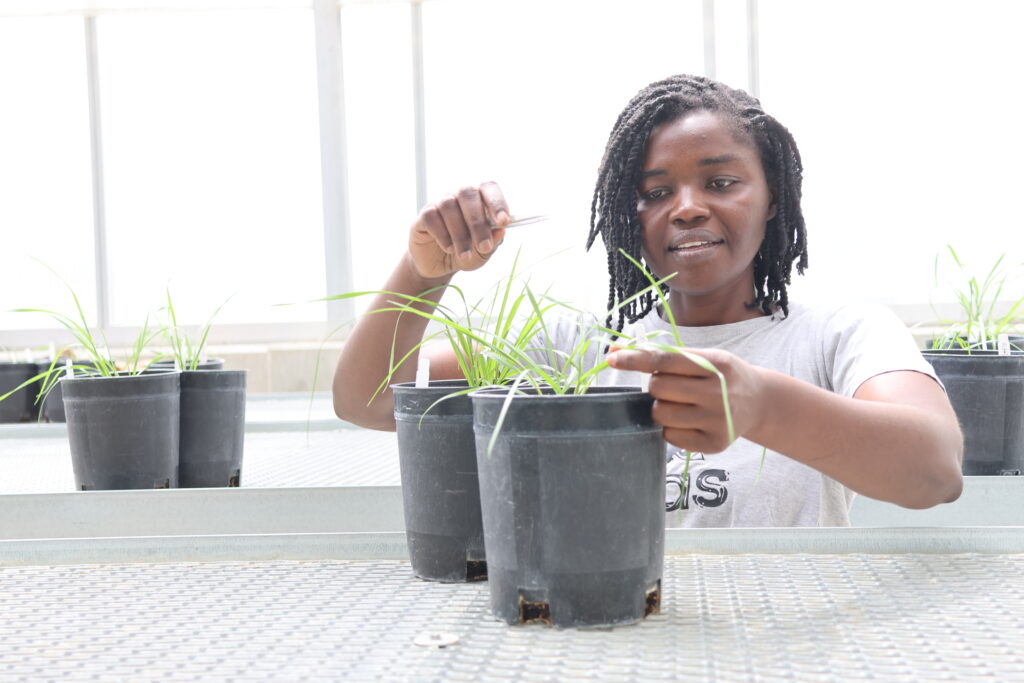
PULLMAN, Wash. — Skills honed on little-known wild papaya plants found in her native Cameroon are helping genomic researcher Raissa Fon decode the genetics of increasingly herbicide-resistant weeds found in Washington grainfields.
A postdoctoral researcher with Washington State University’s Department of Crop and Soil Sciences, Fon is assembling a reference genome — a complete genetic makeup of a given species — for five common Northwest weeds, including Italian ryegrass, tumble mustard, common lambsquarters, mayweed chamomile, and Russian thistle.
“Weeds are adapting to become resistant to herbicides, and scientists are trying to find the genes that are responsible,” Fon said. “But we can’t identify or map them without their reference genome.”
Over the last 20 years, reference genomes have aided scientists’ understanding of the genetics behind important crop traits like disease resistance, plant height, and yield. Many of the world’s most valuable staple crops, like wheat, rice, and corn, have had a reference genome developed.
Now, weed scientists are developing reference genomes of weeds to identify the genes controlling traits like herbicide resistance, seed longevity, and drought tolerance, which give these plants their competitive advantage over crops.
“To better understand herbicide resistance mechanisms, we need to do genomic studies with weeds just as we’ve already done with crops,” said Olivia Landau, a weed scientist with the USDA-Agricultural Research Service’s Wheat Health, Genetics, and Quality Research unit and principal investigator on Fon’s project.
Over the coming year, Fon will cultivate weed species and ultimately assemble their genomes, extracting their DNA and producing genomic sequencing data. Afterward, she aims to map and identify the specific genes responsible for herbicide resistance.
Future scientists may be able to use this knowledge to develop new weed control strategies, breed more manageable weed varieties, or suppress the expression of resistance-related traits.
“Once we find the genes, we could, for example, cause a mutation that knocks out resistance,” Fon said.
Her current work draws on skills that Fon gained as a doctoral researcher at the University of Illinois Urbana-Champaign. There, she helped identify the chromosomes responsible for sex determination in wild papaya species, Cylicomorpha solmsii, a threatened plant found in the highlands of Cameroon.
“Cylicomorpha solmsii has never been domesticated or exploited,” she said. Reputed for its pharmaceutical potential, the little-studied plant has been used by local residents to treat headaches, diarrhea, and other medical conditions.
Ninety-five percent of plant species are hermaphroditic, but Cylicomorpha solmsii is among the 5% that split between male and female plants. Understanding this species could aid in the conservation of valuable plant diversity, Fon said, as it could serve as a new model for studying the evolutionary processes underlying sex chromosome differentiation.
On July 30, 2025, Fon shared her findings as she successfully defended her doctoral degree at the University of Yaoundé I in Yaoundé, Cameroon. She plans to always remember that milestone as “Cylicomorpha Day,” in honor of her ecological and genomic journey.
“That day marked the culmination of nearly seven years of dedicated work on a plant that was gradually facing extinction,” Fon said. “Cylicomorpha’s biology and genomic resources are now being preserved and revitalized.”
For her efforts, Fon was one of 10 early career scientists to receive the 2025 Next Gen Leadership Award from the Genome Partnership, an arm of the international genomics organization Advances in Genome Biology and Technology. The award was announced earlier this year at the organization’s Agricultural Meeting.
Fon has a passion for bioinformatics, the scientific discipline that combines biology with technology to understand biological data.
“Ever since my undergraduate days, I’ve been interested in DNA,” she said. “I’ve wanted to be at an institution where I have the resources to work on it.”
Partnering with WSU and USDA-ARS scientists after she arrived at WSU last summer, Fon is excited to unlock new genetic mysteries.
“Genomic research takes a lot of skill, patience, and troubleshooting” she said. “But getting results is fascinating, and I love it.”