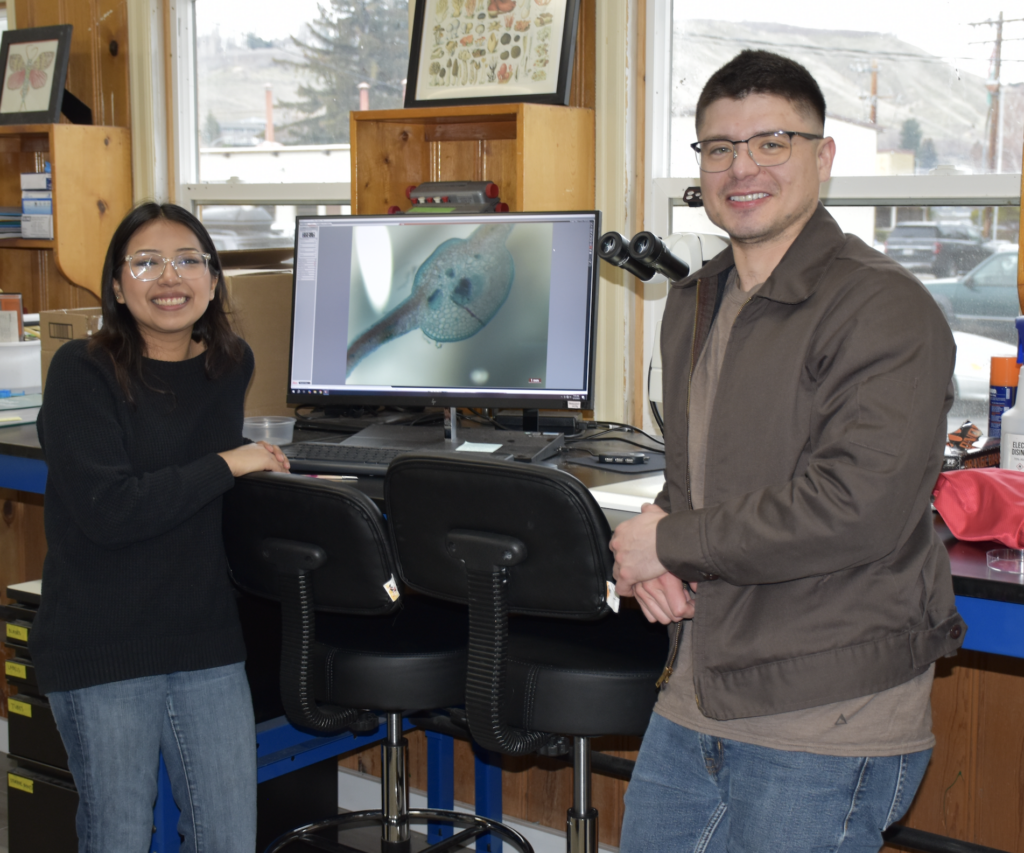
Scholars Cesar Reyes Corral and Monica Oropeza can’t wait for the state-of-the-art infrastructure that the new, donor-supported Plant Growth Facility at Washington State University’s Tree Fruit Research and Extension Center will bring.
Reyes Corral, who graduates with his doctorate in entomology this summer, and Oropeza, a Wenatchee Valley College student and research employee at the Center, expect the discoveries that they and fellow scientists and students are making at Wenatchee will make lasting impacts thanks to the much-needed upgrade, a 2025 CougsGive featured fund.
“Imagine how far our research could go if we have facilities that are on par with the work we’re doing?” says Reyes Corral, who is studying innovative uses of native fungi to kill codling moth, a perennial pest of organic fruit orchards.
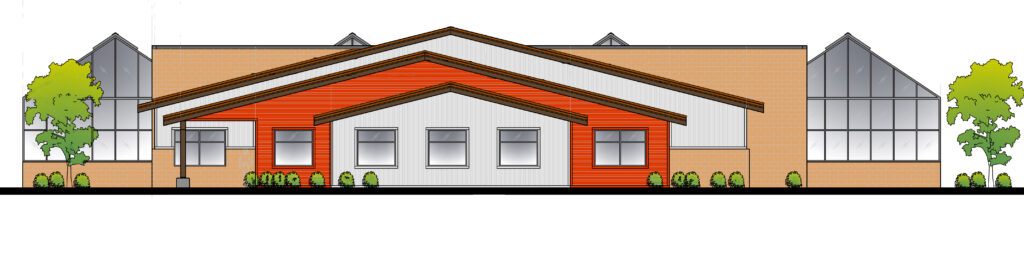
Powered by public and tree fruit industry donors, the new Plant Growth Facility will replace a 70-year-old structure that is long past its prime. The modern building will enable sophisticated environmental stress experiments, year-round disease research, root health tests, and pest-free plant growth serving the state’s $10 billion tree fruit industry, a key Washington economic powerhouse. To complete the project, researchers seek to raise $4.2 million in 2025.
Milne Fruit Products, a Prosser, Washington-based global fruit juice and puree company challenges all supporters of Washington tree fruit to contribute to the Plant Growth Facility fund during CougsGive. Milne Fruit is a silver-level sponsor of the new facility.
“At Milne, we see the value in creating a state-of-the-art facility for research and discovery that continues the growth of our industry” said CEO and President Michael Sorenson. “Our company believes in making a bright future for Northwest tree fruit. The Plant Growth Facility is a much-needed resource for continued success, and we’re excited to help make it a reality.”
New tools to solve problems
Reyes Corral’s work at Wenatchee is based on a lucky stroke: the discovery of three types of fungi, including a strain of the “zombie” Cordyceps fungus that inspired the show “The Last of Us,” that parasitize and kill the apple-ruining codling moth larvae. But to grow and study them with the goal of orchard application, he needs chambers where he can reliably control the environment.
“A few degrees Fahrenheit may not seem like much, but for fungi it’s very important,” Reyes Corral said. “Our existing temperature-controlled rooms where we grow the fungi are really temperature-uncontrolled.”
With the new facility, Reyes Corral could more quickly and reliably study the spores’ effectiveness, ultimately developing new tools to sustainably manage pests.
“Curiosity is what keeps me going,” he said. “I love finding ways to solve problems and want to stay in whatever field allows me to do science.”
Excited about graduation and the next steps in his scientific career, Reyes Corral had a positive experience working at TFREC as an international student. Research happening at the Wenatchee center places it among the most sought-after destinations for tree fruit-minded graduate students.
“With the new Plant Growth Facility, it’s going to reach the next level,” Reyes Corral said. “I can only imagine how much more scientifically powerful this experience is going to be for future generations.”
Transforming research and industry
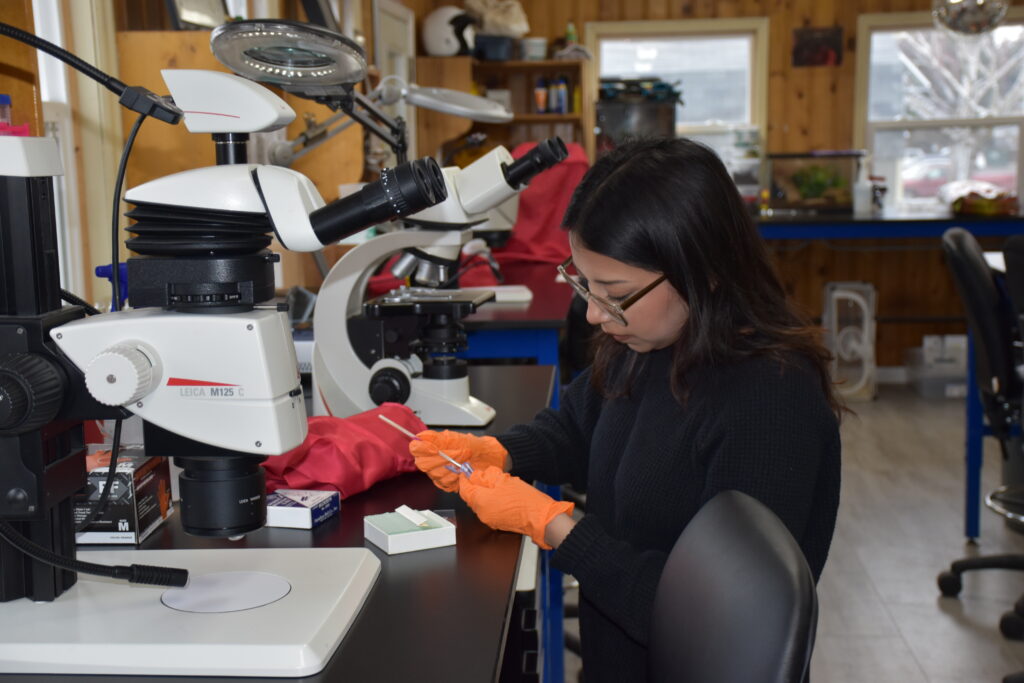
For Monica Oropeza, a former intern, current Wenatchee Valley College student, and research employee at TFREC, a new and better building would not only improve her work but draw other students from the region to the center and to careers in tree fruit science.
She plans to transfer to WSU in 2026 to earn her bachelor’s degree in tree fruit production and horticulture.
“Once I realized how much research is happening here, it pulled me in!” Oropeza said.
She studies leafhoppers, the tiny insect vector of X disease, which causes small, misshapen, tasteless cherries. Like Reyes Corral, Oropeza struggles with maintaining an effective environment for her insect work due to the aging infrastructure. In fact, the old building’s challenges pose a problem for nearly every team at TFREC, from plant pathologists to crop breeders.
The current facility is simply not adequate for experiments that need tight insect controls, said Tobin Northfield, a WSU entomology professor who works with Reyes Corral and Oropeza.
“The new plant growth facility will help us grow and maintain insect-free plants without being impacted by invading pests, and more effectively raise colonies and study impacts and controls of pests that spread damaging diseases,” Northfield said. “It’s really going to be a game-changer for all of us.”
Oropeza shared her thanks with all donors who help build the new facility.
“Wait and see,” she said. “We will prove to the entire industry how much it will benefit us and how many new answers we can find.”
• Support the new Plant Growth Facility at Wenatchee by becoming a CougsGive donor. Give on Wednesday, April 16, at the WSU CougsGive website.
• Tree fruit scientists at Washington State University help make a more resilient Washington by solving agricultural challenges and developing new varieties and ideas. Learn about our mission at https://cahnrs.wsu.edu/resilient-washington/