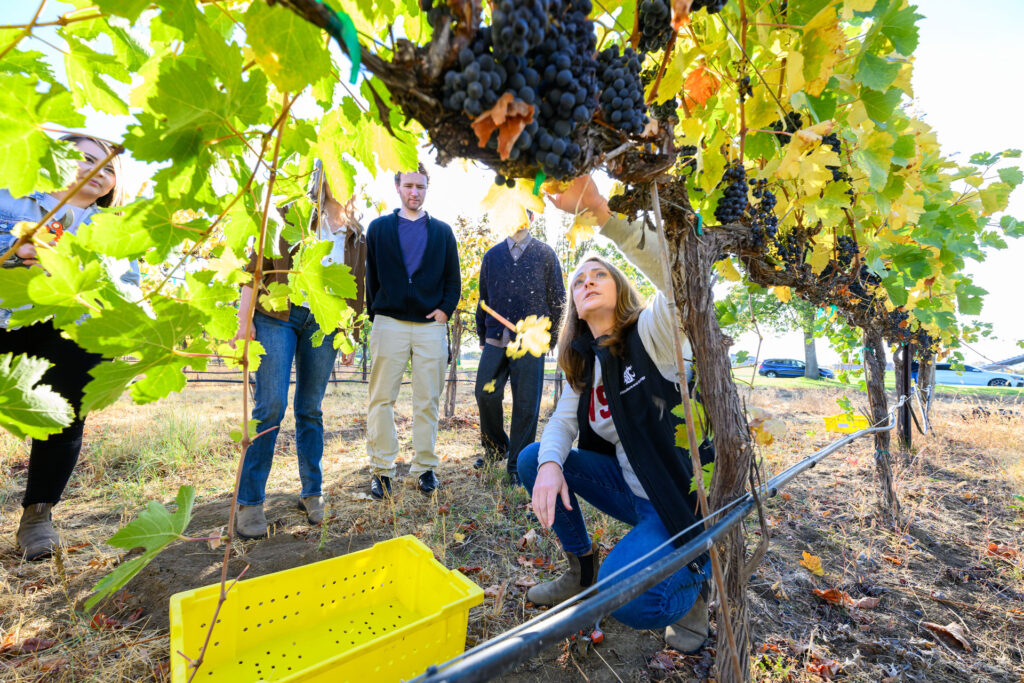
(Photo courtesy of Bob Hubner/WSU Photo Services)
RICHLAND, Wash. — Beginning this fall, students can pursue an advanced degree in viticulture and enology at Washington State University.
Offered via the university’s Tri-Cities campus, the new master’s degree helps solidify WSU as a global leader in graduate-level wine science research by preparing students for successful careers in an evolving industry.
“The wine industry increasingly recognizes the need for a workforce with deeper education, stronger scientific understanding, and the critical thinking skills required to address complex challenges, from climate change to shifting consumer preferences,” said Jean Dodson Peterson, founding chair of WSU’s Department of Viticulture and Enology. “This is the right time for us to lean into that need. An advanced degree in viticulture and enology fills an important gap and will help strengthen the future of the industry.”
Previously, WSU V&E students could pursue a master’s degree in either food science or horticulture. While aspects of both disciplines are woven into the new degree, the curriculum takes a more targeted approach by focusing on Washington’s unique wine grape growing region and climate.
“Our team is excited to continue engaging as affiliate faculty in horticulture,” Dodson Peterson said. “This is not about creating a new silo. It is about strengthening our college by building on existing partnerships and creating new opportunities for collaboration.”
Dodson Peterson and a team of V&E faculty used survey results from current graduate students, recent alumni, and industry members to guide their curriculum development process. The result is a flexible degree that allows students to focus on enology, viticulture, or a mix of both.
WSU also partnered closely with the Washington State Wine Commission, a government agency that supports and represents wineries and grape growers throughout the state.
“Building on the legacy of pioneers like Walt Clore and Chas Nagel, the Washington wine industry continues to advance through a commitment to research and education. This program represents an important step forward in that tradition,” said Kristina Kelley, the commission’s executive director. “The industry will benefit from a growing pool of highly trained professionals with specialized technical expertise who understand how to collect and analyze vineyard and winery data to support informed, fact-based decision-making.”
The new degree is designed to be completed in two years. Students will take a heavy courseload during their first year and work on their graduate research projects throughout both years.
“The viticulture and enology department’s dedication to the thoughtful development of this degree is commendable,” said Raj Khosla, Cashup Davis Family Endowed Dean of WSU’s College of Agricultural, Human, and Natural Resource Sciences. “The degree’s combination of curriculum, research, and hands-on learning will ensure our students are competitive, knowledgeable, and career-ready in an industry that is undergoing significant change. I’m eager to witness the many new opportunities it will offer.”
Among the required core courses are a science writing workshop, a seminar focused on career development and current V&E topics, and a statistics class covering principles of experimental design, data analysis, and interpretation. Students can choose from more than a dozen viticulture- or enology-focused electives, depending on their individual research focus and interest.
With cross-institutional collaboration now becoming the norm, graduate students will be encouraged to work with their counterparts at other universities around the world, Dodson Peterson said.
“A graduate degree teaches students how to think critically and solve problems while instilling in them a passion for lifelong learning,” she added. “Our department focuses on conducting research in industry settings and establishing collaborative industry relationships. This approach helps students better understand industry challenges while showing them how to put innovative, data-driven solutions into practice.”
Watching the degree come to fruition has been both fulfilling and exciting for Dodson Peterson, who is especially grateful for the encouragement of WSU leadership.
“As a team, we felt truly supported throughout this process,” she said. “I hope the changes we are making, from integrated learning opportunities and more industry-connected conversations to expanded research capacity, will have a lasting impact on the economic sustainability of the wine and grape industry in Washington and beyond.”
Voice of the Vine
Subscribe to the Voice of the Vine newsletter for stories about the latest emerging research from WSU’s Department of Viticulture and Enology, profiles of students, alumni, and researchers working in Washington’s world-class wine industry, info on upcoming events, and much more.