Scientists in Washington State University’s College of Agricultural, Human, and Natural Resource Sciences (CAHNRS) will present innovations shaping the future of tree fruit agriculture at FIRA USA 2026.
CAHNRS is a sponsor and strategic partner of the U.S. conference of the International Forum on Robotics and Automation, gathering Oct. 20-22 in Yakima, Washington.
“Advances in automation could solve some of the toughest problems facing tree fruit growers, from labor shortages to environmental extremes,” said Raj Khosla, Cashup Davis Family Endowed Dean of CAHNRS. “FIRA brings the brightest minds in the field together to seed collaboration and discovery, and our college is proud to support this exciting exchange.”
The college is a co-organizer of Innovation Day on Wednesday, Oct. 21 and organizer of Campus Day on Thursday, Oct. 22. CAHNRS faculty are also planning the 2026 field day and networking social on Oct. 22.
Innovation Day spotlights the latest breakthroughs in agricultural robotics and technology through a series of panels, lightning talks, and poster sessions.
Campus Day connects robot manufacturers, researchers, industry professionals, and K-12 students for an up-close look at future-farm technologies. Organized by the college’s Student Success and Academic Programs office and faculty at WSU’s Irrigated Agriculture Research and Extension Center, this event will include a main stage discussion, participation by area youth robotics teams and schools, and a “Meet the Robots” live parade of technology.
College leadership, faculty, and students from labs specializing in technology and outreach will also share discoveries benefiting tree fruit at multiple panels, talks, and tours:
- CAHNRS Dean Raj Khosla, founder and past president of the International Society of Precision Agriculture, will join industry, agency, and university experts for the “Cultivating Innovation: Technology Needs and Opportunities in Agriculture” panel.
- Matthew Whiting, WSU professor and Extension specialist in tree fruit agriculture, will moderate the Cultivating Innovation panel.
- Professor Troy Peters, director of WSU’s Center for Precision and Automated Agricultural Systems, will lead lightning talks on digital agriculture and robotics and automation from seed to harvest.
- Lav Khot, professor and director of WSU’s AgWeatherNet, will join an Innovation Day panel, “Public-private partnerships focused on agricultural innovation,” lead the “Smart Farms in America: University and Industry Prospective” session and co-host the Smart Orchard Field Day and Networking Social at Gilbert Cellers in Yakima, Washington.
- Tree Fruit Extension Specialist Bernardita Sallato will co-lead the first FIRA Spanish session for farmers, “Del campo a la tecnología: cómo los trabajadores agrícolas se adaptan a las granjas automatizadas,” lead Thursday’s “Smart Irrigation: Rethinking Water Management with AgTech & Automation session,”and co-host the Smart Farm tour.
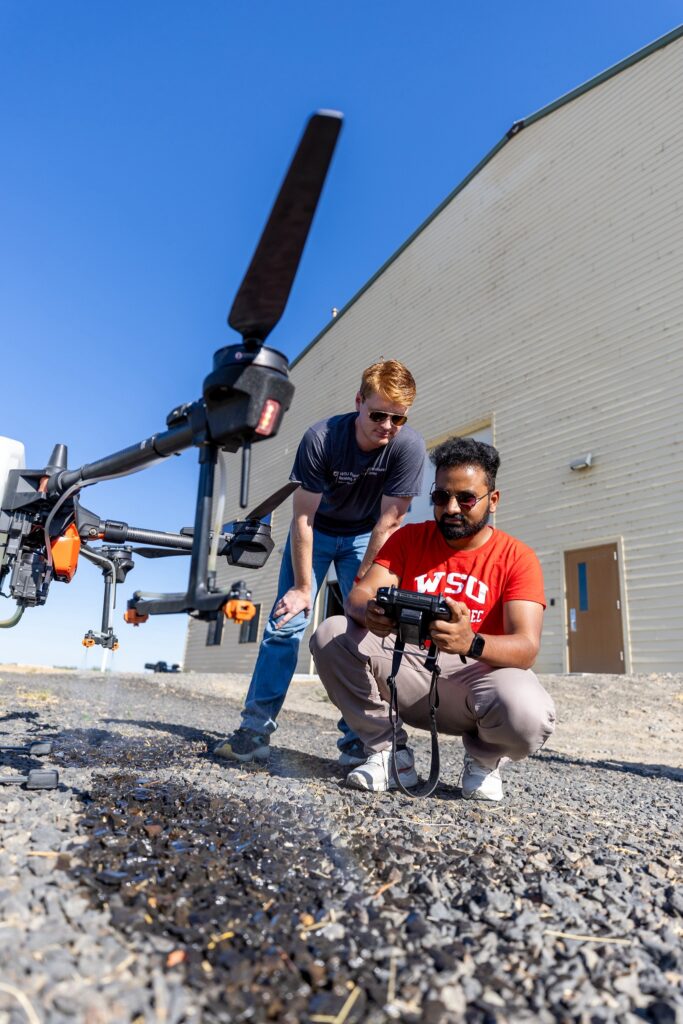
- Martin Churuvija, assistant professor in Smart Machine and Robotics Systems Engineering, will showcase AI-powered robotic pruning technology designed to reduce labor demands in tree fruit production. He will also highlight his research in lightning talks and poster sessions.
- Dattatray Bhalekar, a Tree Fruit Extension Educator, will facilitate the “How AgTech Is Transforming Crop Load Management” panel and share WSU Precision Ag Lab research on autonomous sprayer technology at the Innovation Day Lightning Talks session.
- WSU Tree Fruit Extension Educators Thiago Campbell, Antonia Sanchez, Lexie McDaniel, Dattatray Bhalekar, and Dani Gray are coordinating the “Horticulture For Engineers” pre-event on October 19. This primer for the conference will equip engineers and technology developers with essential specialty fruit horticultural practices, operational insights, and field considerations to improve collaboration between the agricultural technology industry and growers to solve real-world challenges.
FIRA showcases WSU’s partnership-driven agricultural technology initiatives, explores emerging solutions, and will expand WSU-managed Smart Farm Testbeds to advance technology evaluation, demonstration, and grower education, Khot stated. The opportunity to see emerging technologies, exchange ideas, and learn directly from industry helps WSU scientists identify where automation technologies can have the greatest impact.
The conference’s Spanish language session is of particular interest for Sallato, who expects it to help her understand how farm workers perceive and adapt to new technology, as well as how scientists can support this process.
“FIRA is an outstanding opportunity to attract technology that could support Washington farmers, as well as learn about growers’ needs,” she said.
About CAHNRS
For over 100 years, WSU’s College of Agricultural, Human, and Natural Resource Sciences has co-created solutions to the challenges faced by the families, growers, and communities of Washington. CAHNRS delivers research, education, and outreach programs that help human families, protect our environment, and keep agriculture and the economy secure. We are active in all 39 Washington counties, two Tribal nations, and across our state’s industries, farms, forests, and watersheds.
Learn more at cahnrs.wsu.edu.
• Contact: Seth Truscott, Communications Coordinator, College of Agricultural, Human, and Natural Resource Sciences, struscott@wsu.edu