PULLMAN, Wash. — Kang Huang arrived at Washington State University less than three years ago. In that short time, he’s procured three significant grants from the U.S.D.A.’s National Institute of Food and Agriculture (NIFA) to help bolster food safety and reduce food waste across the country.
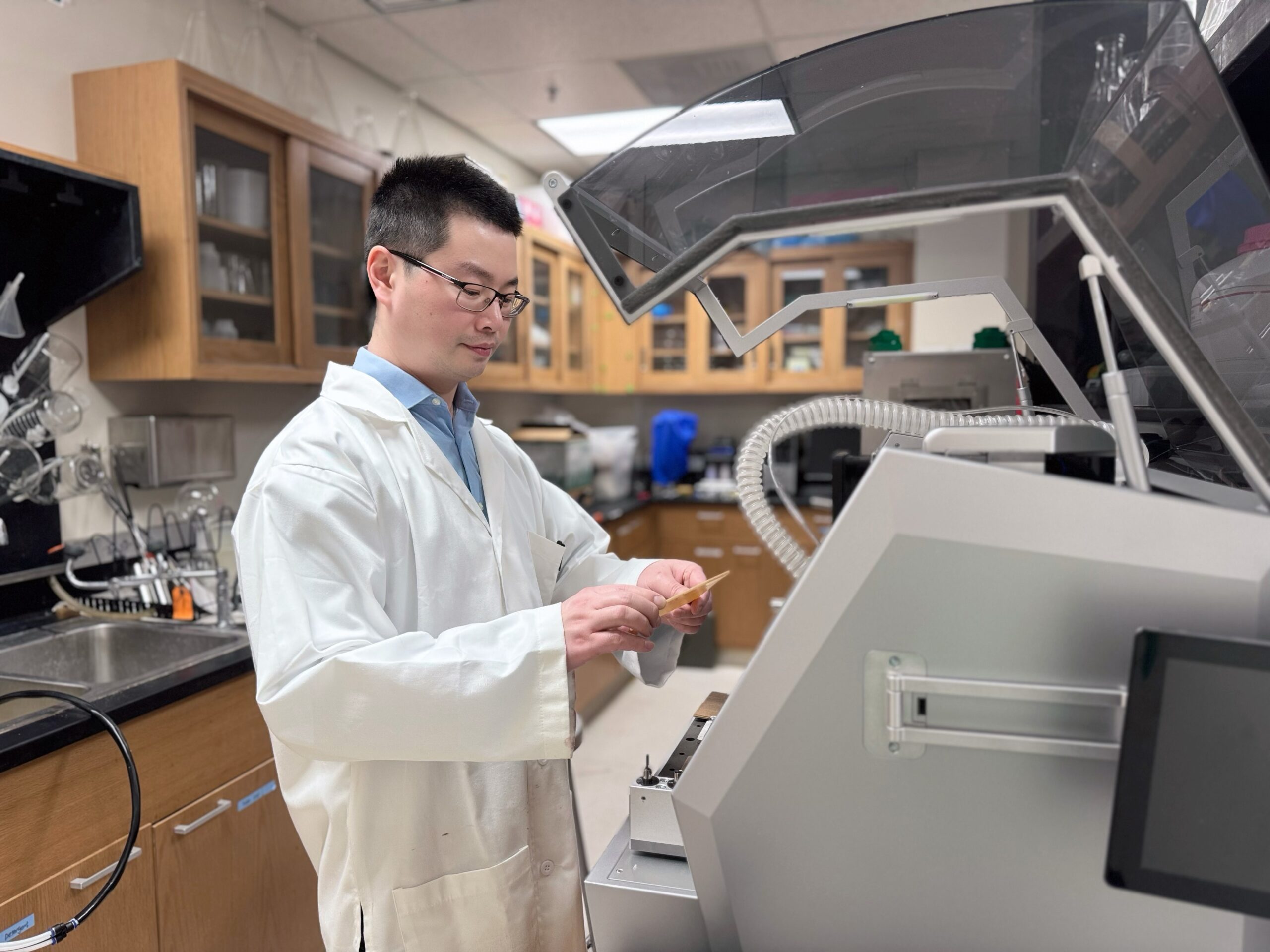
Each project is focused on a different stage of food production: pre-harvest, processing, and post-processing.
“They all seem different, based on the timing of the food process,” said Huang, an assistant professor in WSU’s Department of Biological Systems Engineering. “But the core of the projects is the same: killing microbes that spoil food and harm people.”
The goal of reducing food waste and improving human health is a perfect example of how universities help communities, said Raj Khosla, Cashup Davis Family Endowed Dean of WSU’s College of Agricultural, Human, and Natural Resource Sciences.
“It is encouraging to see our faculty leading projects with real world impact, reducing spoilage and enhancing food safety,” Khosla said. “I’m excited to see how Dr. Huang’s work progresses over the next few years.”
The newest NIFA grant, for $650,000 over three years, supports work to develop new food-safe coatings that slow spoilage of food after it is harvested. The coatings could be applied on different surfaces, including plastic, metal, glass, or other types of food packaging containers.
“40% of food produced in the U.S. is never eaten,” Huang said. “If we can reduce microbial spoilage, that means less food waste.”
Antimicrobial coatings already exist in biomedical labs and other settings. Those coatings can reduce or eliminate microbes, but they aren’t food grade. Huang and his team will take knowledge from the existing coatings and work to engineer a food-safe version.
The second NIFA grant, also $650,000 over three years, aims to make the environment of food processing safer using artificial intelligence (AI). Currently, food processing facilities must clean surfaces and use swab tests to ensure all harmful microbes have been eliminated. It can take up to two days to see results.
Huang and colleague Meijun Zhu, professor in WSU’s School of Food Science, are developing a “smart sticker” to be applied on surfaces that need cleaning. After the area is sanitized, that sticker is removed, and the facility would use a vibrational spectroscope to gather data from it. Then, they would use an AI-based model to predict how much bacteria was killed during sanitation.
“Food processing companies routinely use swabs at multiple locations throughout their facilities, often hundreds of times each week,” Huang said. “These companies are regulated closely and need to monitor the cleanliness of their environment. If our technology is successful, it could significantly reduce costs.”
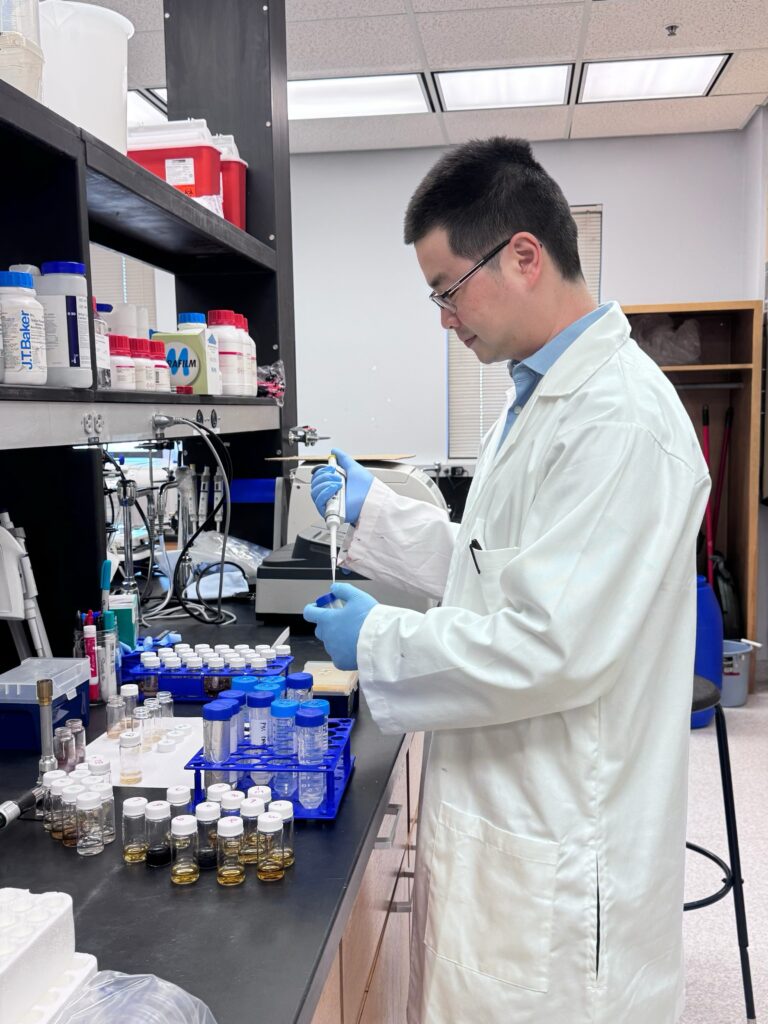
Huang received the other NIFA grant in 2024. The $1 million four-year project involves Frank Zhao and other colleagues in WSU’s Department of Plant Pathology. The team is looking to improve biopesticides that protect food before it is harvested. The focus is on fighting fire blight in apples, but the findings could also be used on other crops.
“The current practice to control fire blight is antibiotics,” Huang said. “However, extended use of those allows bacteria to build up resistance. We want to minimize antibiotic use, while still helping growers fight the disease.”
Biopesticides are disease-fighting agents, like viruses, made from ingredients found in nature. They include plant-based extracts, like essential oils, micro-organisms that can inhibit the growth of disease-causing organisms, or nucleic acids. Huang’s team is looking at the first two as potential solutions.
Currently, biopesticides aren’t commonly used in apples because they aren’t stable in the field, often degrading in sunlight and dry environments.
“One hour of sunlight kills over 90% of viruses,” Huang said. “We want our project to work under normal field conditions, so anything we create must work in sunlight and outdoors.”
The team aims to develop a formulation that demonstrates promising antimicrobial activity comparable to antibiotics in field trials.
“We need to increase the testing to make sure those numbers remain consistent in larger scale testing,” Huang said. “And we want to promote biopesticides with growers. This grant is for research, education, and Extension work, so we’re partnering with growers to share the results of our research.”