
PULLMAN, Wash. — Washington State University Regents Professor Scot Hulbert is leading the College of Agricultural, Human, and Natural Resource Sciences (CAHNRS) as acting dean this summer, continuing its mission of research, service, and education for all.
He assumed the new position on June 16, 2025, and will remain in the role until Sept. 1, when Raj Khosla joins CAHNRS as the new Cashup Davis Family Endowed Dean.
“My goal is to ensure that Raj starts out on the right foot,” Hulbert said. “I’m keeping him apprised of what I’m doing, involving him in the college’s decision-making, and teaching him about WSU and our priorities. CAHNRS will look different this year due to budget cuts, and I want to help Raj by getting some of the harder, less glamourous jobs out of the way.”
Hulbert brings a history of leadership to the role, having served as chair of WSU’s plant pathology department, CAHNRS Associate Dean for Research, CAHNRS Senior Associate Dean, and director of WSU’s Agricultural Research Center.
Earlier this month, Hulbert’s leadership was recognized on a national level by agInnovation-West, which honored him with its Excellence in Leadership Award. He served as former chair of the organization, which is part of a network of agricultural research stations throughout the U.S. and a unit of the Association of Public and Land-grant Universities.
Hulbert’s ties to both agriculture and WSU run deep. Growing up on a farm near the WSU Mount Vernon Northwestern Washington Research and Extension Center, he has early memories of biking into the fields to talk to a WSU entomologist working in the region. Hulbert’s family grew vegetable crops for a variety of seed companies, and his fascination with plants developed after a childhood spent interacting with breeders from around the world.
A WSU alumnus, Hulbert comes from a long line of Cougs. Hulbert Hall on the Pullman campus is named after his grandfather, a farmer in the Skagit Valley who served as a WSU Regent at just 29 years old.
“In my family, WSU was where you went to school,” Hulbert said. “It wasn’t really negotiable.”
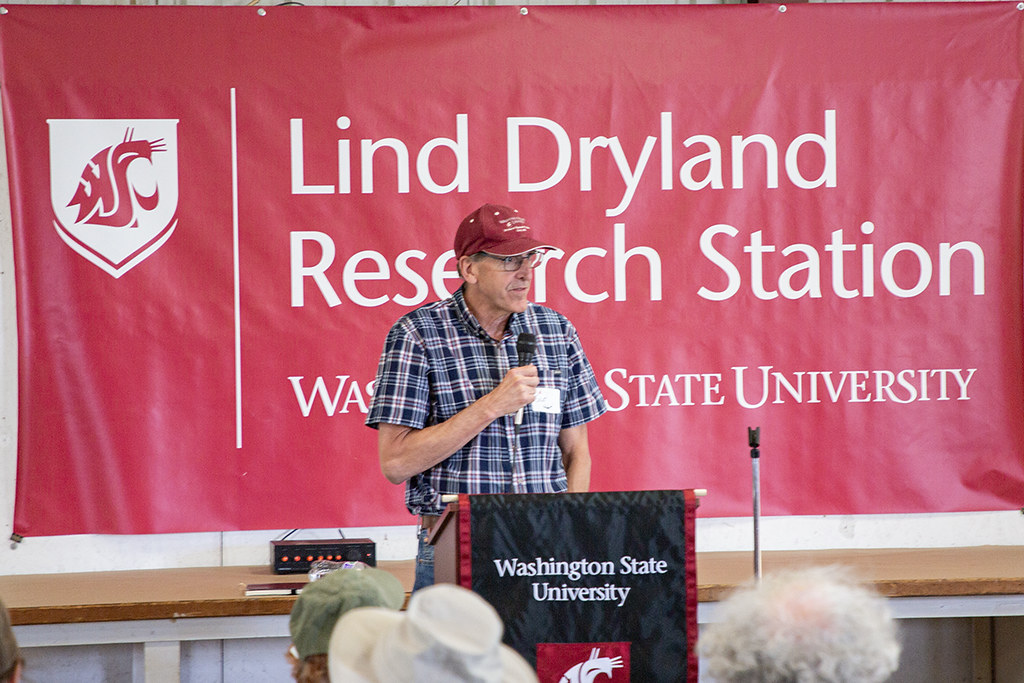
In keeping with that tradition, Hulbert pursued a bachelor’s degree in horticulture at WSU, then earned a master’s degree in vegetable crops and a doctorate degree in genetics from the University of California, Davis.
“My goal was to become a plant breeder,” he said. “Genetics was my field, and plant diseases became my specialty.”
After receiving his PhD, Hulbert relocated to the Midwest, working first as a postdoctoral researcher at Purdue University and later as a faculty member in Kansas State University’s Department of Plant Pathology. When he learned of an opening at WSU for the R. James Cook Endowed Chair in Cropping Systems Pathology, Hulbert dropped his name in the hat.
“The fact that it was my alma mater was a main reason I applied,” Hulbert said. “I also wanted to get back into agriculture. Washington’s diversified cropping systems are perfect for people like me who are interested in research and development. Our farmers are progressive and will try new things. WSU is unique in that it has a lot of breeding programs and a lot of breeders.”
Since returning to WSU as endowed chair nearly two decades ago, Hulbert has found numerous reasons to stick around CAHNRS.
“It has always felt really good to give back to my alma mater through leadership roles,” Hulbert said. “CAHNRS punches above its weight, and high production is the norm. Our faculty and staff are dedicated to the cause, and we have a culture of working hard to make this college a better place. I’m a lifelong research lover, and that’s one of the things that CAHNRS does best.”
As Associate Dean for Research, Hulbert enjoyed learning more about the CAHNRS departments that he was less familiar with. Later, as the college’s Senior Associate Dean, he worked closely with academics and Extension. Both roles have provided him with a comprehensive understanding of CAHNRS that will be fundamental to his success as acting dean.
“Our college has a lot of important, interesting research that is not agriculture related,” Hulbert said. “As Associate Dean for Research, I knew what everyone in the college was doing. Every time I heard about a new project, I wished I was the one working on it!”
During this summer’s transition period, Hulbert’s message to CAHNRS stakeholders is a simple yet urgent one.
“University research, Extension, and teaching the next generation is so important,” Hulbert said. “I hope our partners can help us work with our legislators to show the current federal administration that our work shouldn’t be taken for granted or trivialized. The environment is changing. Our society is changing. We must keep agriculture strong.”
About CAHNRS
The land-grant mission of WSU’s College of Agricultural, Human, and Natural Resource Sciences is made possible through the U.S. Hatch Act of 1887 and the U.S. Smith-Lever Act of 1914. Respectively, these Acts fund experiment stations and cooperative Extension efforts that aid Northwest growers, provide nutrition and health education, support rural businesses, enhance our environment, and much more. Hatch and Smith-Lever capacity funds drive our work for a more resilient, prosperous, and sustainable Washington and are matched by state and local funds.