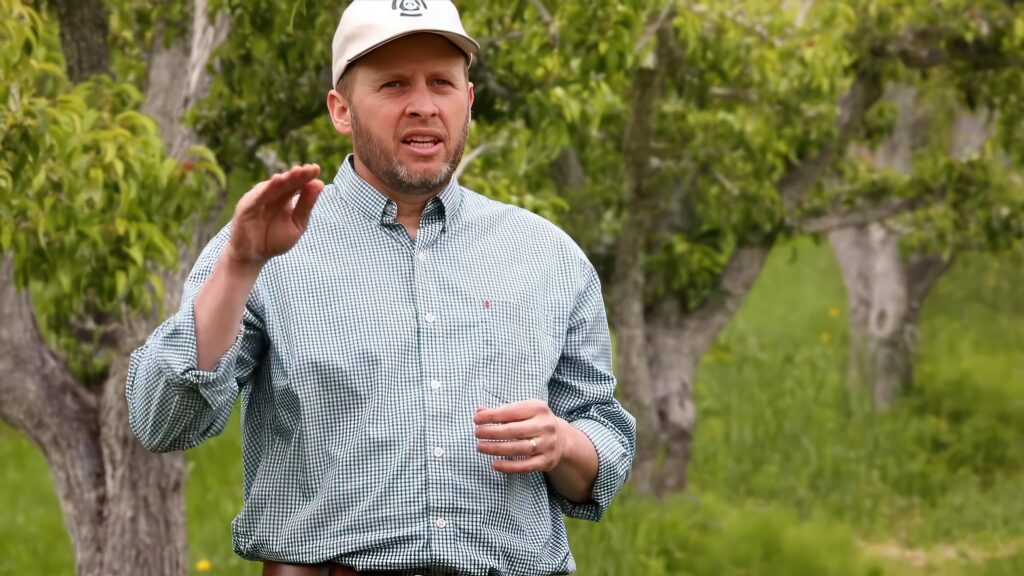
PROSSER, Wash. — Growing up, Troy Peters spent his summers on an Idaho farm, loving the work and time spent outdoors. Graduating from college with an engineering degree, he worked in an office for three years.
“I decided I couldn’t spend my career in a cubicle,” said Peters, a professor and agricultural engineer with Washington State University. “I had to get outside and knew I liked working with people in agriculture.”
Peters returned to school and earned a PhD, which eventually led him to his position as an irrigation specialist at WSU’s Irrigated Agriculture Research and Extension Center in Prosser. Now that decision he made in 2000 has led to his selection as the new director of WSU’s Center for Precision and Automated Agricultural Systems (CPAAS).
“Troy will do great work leading CPAAS,” said Wendy Powers, Cashup Davis Family Endowed Dean of WSU’s College of Agricultural, Human, and Natural Resource Sciences. “His research background, experience collaborating with industry as an Extension specialist, and years working at WSU are perfectly suited to lead the center forward doing impactful work for our state.”
The new director is ready and has goals already in mind.
“I’m very excited about this new role,” said Peters, who has been with WSU at Prosser since 2006. “I want the center to do work that is valuable to the ag industry and to produce tools that solve problems.”
His highest priorities are to increase collaboration with industry and advance existing work that may have stalled because a new technology isn’t yet ready for consumers.
“There are so many good ideas that can save time and money in agriculture, but that still have problems that need to be worked out,” Peters said. “I hope that CPAAS can both advance the science on these ideas and work on the engineering issues that exist to take them closer to commercialization.”
A long-time expert in irrigation systems, Peters, who is in WSU’s Department of Biological Systems Engineering, believes more precise use of water could be a huge breakthrough to save more of the precious resource.
“In precision irrigation, we can continue to create better management algorithms,” he said. “Those algorithms can make new maps of a field on the fly so that the system can change water levels in different parts of a field. That way areas that aren’t as dry get less water.”
Over the course of his career, Peters has researched and promoted several waste-reducing breakthroughs in irrigation. For instance, he demonstrated the impact of switching from conventional methods to low elevation spray sprinklers on center pivot irrigation systems to growers.
Moving sprinklers closer to the ground reduces water usage by 15 to 20%, Peters said. Approximately 80% of irrigated farms in Washington use center pivot systems, so the water savings are significant.
“It’s been really encouraging to see people convert their systems because of the data I can show them,” he said. “It saves water, it saves energy — it’s a very impactful change.”
Making a real difference that improves life for farmers and consumers is what drives Peters in his work. With his new role, he aims to make an even bigger impact.
“There are so many things we can do in CPAAS,” he said. “I’m excited to get started working on them.”