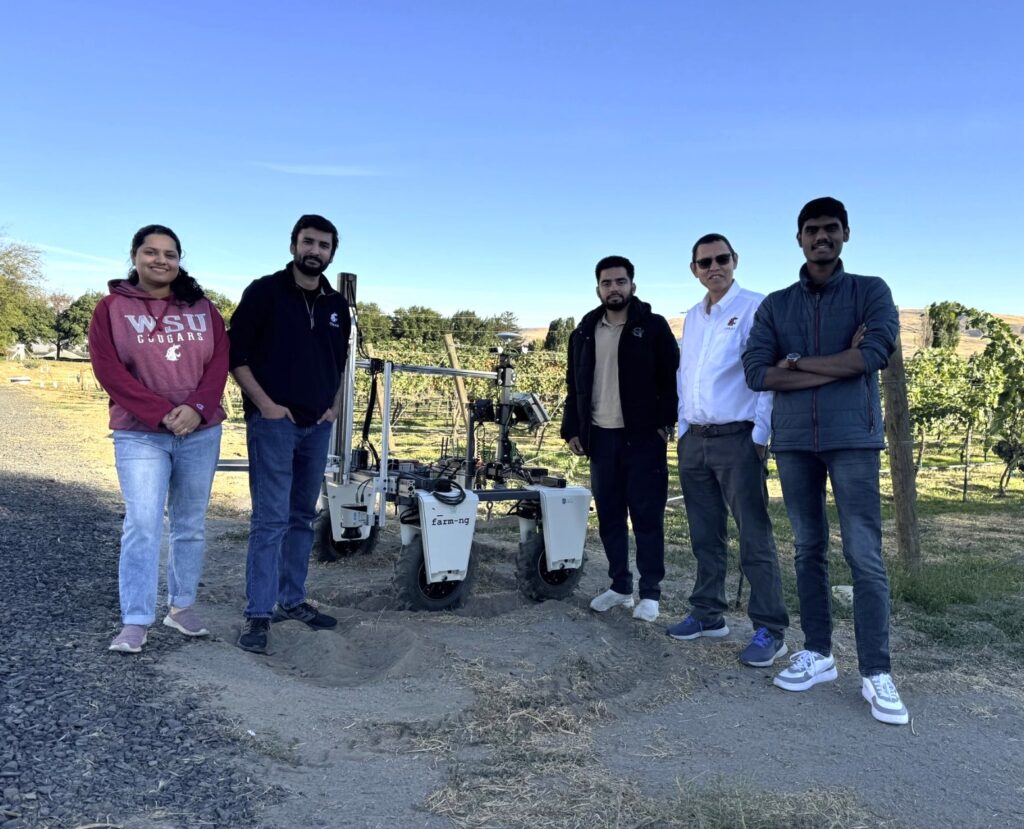
WOODLAND, Calif. — An autonomous fruit bin hauling robot developed by Washington State University graduate students and Heritage University undergraduates caught the eye of judges in a recent farm robotics competition.
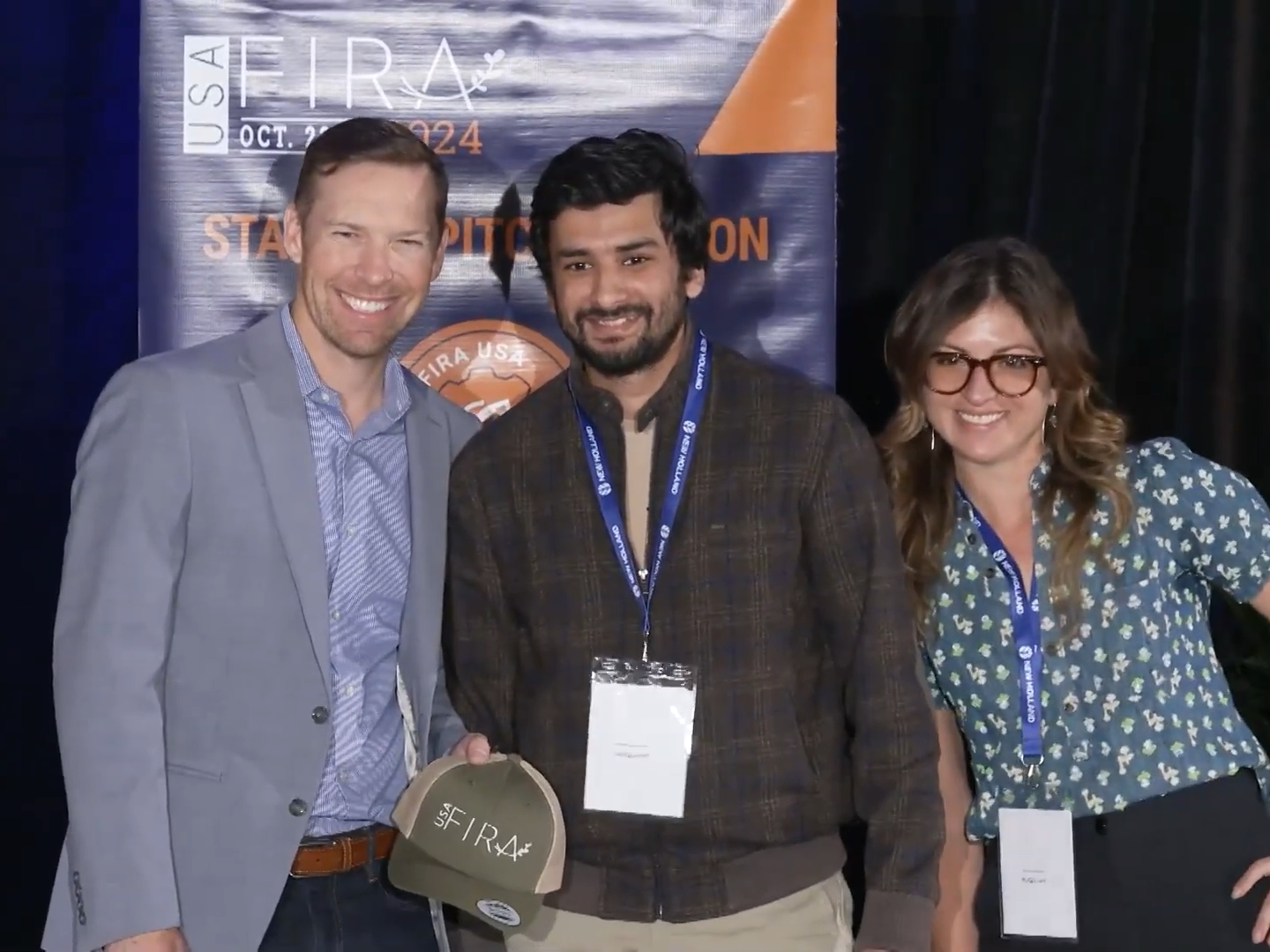
The 10-person team received the Excellence in Small Farms Technology Award and a $5,000 cash prize for their success in the Farm Robotics Challenge, an annual student competition coordinated by the University of California and the AI Institute for Next Generation Food Systems, with support from agriculture tech company farm-ng.
“I was happy with the creativity and hard work of the students, and confident they would stand out in the competition,” said Manoj Karkee, director of WSU’s Center for Precision and Automated Agriculture Systems (CPAAS) and team co-advisor. “The award was a great validation of their efforts.”
The challenge’s five winning teams were announced at the 2024 FIRA USA agricultural robotics conference in Woodland, California. The contest marks the first time CPAAS has received such a prestigious award for a robotic invention.
“It was a joyful moment to see the team’s dedication recognized,” said Safal Kshetri, CPAAS post-doctoral researcher and team co-advisor. “This challenge provided a valuable opportunity for the students to apply their theoretical knowledge to real-world challenges in impactful ways. The award is well-deserved and reflects their commitment, creativity, and teamwork.”
Challenge participants designed robots to solve problems impacting the agriculture industry. After speaking with several Washington state growers about bin handling efficiency in tree fruit orchards, the WSU/Heritage University team, led by WSU PhD student Dawood Ahmed, began constructing a high-tech solution that could improve the process.
The group aimed to successfully automate the movement of empty and full fruit containers in and out of orchard rows. When performed manually, it’s a process that can be labor-intensive, costly, and result in damaged fruit.
“We designed a robot that would autonomously go into the orchards, see a bin full of fruit, align itself with the bin, then pick it up and take it to a designated loading area,” said Ahmed, who is pursuing a biological systems engineering degree with an emphasis on agricultural automation. “Afterward, it would start the journey over again.”
One WSU team member worked on the mechanical and navigational components of the robot, while two others worked on determining what the robot would “see” through a camera, training the robot’s AI model for accurate fruit bin detection. The Heritage University students assisted with various visual, mechanical, and design aspects of the project, which received supporting funds from the WSU-led AgAID Institute.
“As the group’s leader, I supervised these parallel efforts,” said Ahmed, who was solely responsible for the robot’s navigation and control aspects. “Once they were complete, I integrated them each into a single robotic system.”
The robot underwent three rounds of testing. First the students observed its navigational abilities indoors, then in a research vineyard near WSU’s Irrigated Agriculture Research and Extension Center, where CPAAS is located. The final test took place in a nearby commercial orchard.

The team contended with a variety of obstacles. They had to replace faulty electrical circuits, find ways to stably mount heavy equipment, and design for field variability and factors like changing sunlight, which initially interfered with the robot’s bin detection abilities.
“The hardest part was figuring out how to make the robot navigate the orchard perfectly,” Ahmed said. “We had to conduct a lot of experimental testing to reach that stage. When the whole integrated system started working, it was a surprising, happy moment for us.”
Another challenge involved how to make the robot change direction and turn around safely at the end of an orchard row.
“This is the first time CPAAS has created a robot that performs row turning successfully,” Ahmed said. “We are really proud of that.”
The team impressed the competition’s judges, which included academics as well as agriculture industry experts and stakeholders, by both the robot’s navigation capabilities and its safety system, which is programmed to change course if the robot detects a human or other obstacles in its pathway.
“A competition like this provides students an opportunity to experience and learn about the complete lifecycle of research and development projects,” Karkee said. “They start with understanding the needs of the stakeholders and end-users, then design an optimal solution.”
The group’s end goal is to continue perfecting the robot for grower adoption.
“By providing affordable and effective solutions, this robotic system can greatly boost the productivity and sustainability of the tree fruit industry,” Kshetri said. “By automating labor-intensive tasks, the system can also address labor shortages and reduce operational costs, providing a practical solution for farmers with limited budgets.”
Ahmed is already excited to get to work.
“We want to take our project to the next level,” he said. “We know some aspects still need improvement, so we’re looking at how we can make the robot even better.”
About CAHNRS
The land-grant mission of WSU’s College of Agricultural, Human, and Natural Resource Sciences is made possible through the U.S. Hatch Act of 1887 and the U.S. Smith-Lever Act of 1914. Respectively, these Acts fund experiment stations and cooperative Extension efforts that aid Northwest growers, provide nutrition and health education, support rural businesses, enhance our environment, and much more. Hatch and Smith-Lever capacity funds drive our work for a more resilient, prosperous, and sustainable Washington and are matched by state and local funds.