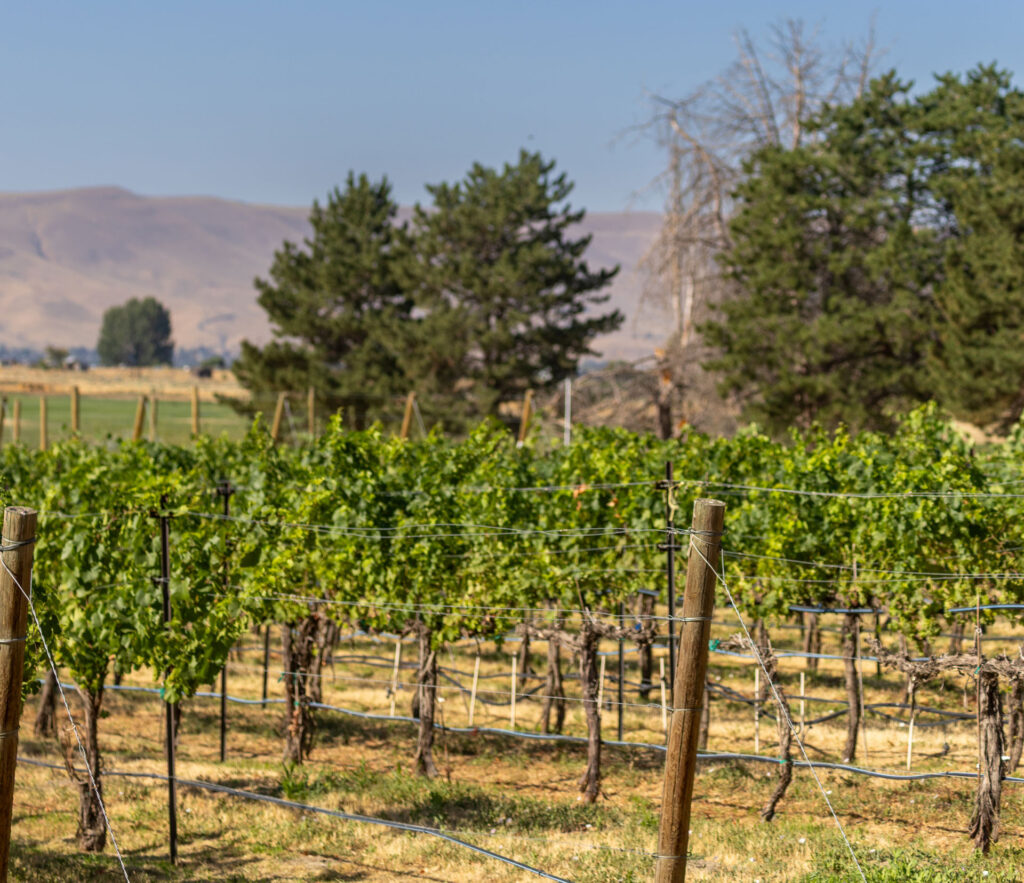
(Photo courtesy of Matt Ziegler/CAHNRS Communications)
PROSSER, Wash. — Winegrape growers throughout the world have searched long and hard for a cultivar that thrives in dry climates and under deficit irrigation. But new research from scientists at Washington State University suggests that a grapevine’s variety likely has no impact on its response to drought.
“Our results go against conventional scientific dogma,” said corresponding author Markus Keller, Chateau Ste. Michelle Distinguished Professor in WSU’s Department of Viticulture and Enology. “The takeaway is that, when making irrigation decisions, growers should focus more on canopy size, soil type and wine style rather than worrying about the inherent physiological differences between varieties.”
The latest paper, published in the journal BMC Plant Biology, builds on two previous WSU articles featured in the same journal. Published in 2023, the first paper focused on the idea that measurements of leaf water potential can be used as a proxy for soil moisture. The second paper, published in 2025, investigated the actual relationship between leaf water potential and soil moisture of 30 grape varieties.
Keller was inspired to pursue this research after reading a landmark study out of southern France decades ago. That study concluded that grape varieties respond either “optimistically” or “pessimistically” to water stress.
Optimistic varieties act as though they will eventually receive more water, so they continue to photosynthesize and produce sugar despite the risk of drying the plant out. Meanwhile, drought conditions prompt the pessimistic varieties to preserve their water status by immediately closing their stomata — the pores that allow water vapor to escape and CO2 to enter the leaf for photosynthesis.
“There is a lot of published research about the perceived need to breed varieties that are better adapted to drought conditions,” Keller said. “However, much of that research also has contradictions — sometimes within the same variety — depending on extent of water stress, time of season, what rootstocks the vines were grafted to, and who did the research.”
After learning that the varieties in the original French study were grown in different blocks and managed slightly differently, Keller knew he had to re-test the findings.
An opportunity to do so came in 2010, when the Washington wine industry provided funding to help create a WSU research vineyard with 30 different winegrape cultivars.
Charles Obiero, a former WSU postdoctoral researcher and co-author on all three papers, used the vineyard to test the optimist/pessimist dichotomy by tracking drought stress responses throughout the growing season. The vines were fully irrigated, followed by a dry-down period that gradually deprived the plants of water. The vines were then irrigated one more time and left to dry down again.
For two years, Obiero recorded the vines’ base-level water status while they rested at night, then followed up with measurements in the midday heat, noting how much the water status had dropped. He also measured the plant’s physiological responses, including stomatal regulation.
“The goal was to understand whether or not growers should irrigate their vines differently depending on the hydraulic strategies of the plant,” Obiero said.
Instead of confirming the expected physiological differences among varieties, Obiero found that whether a variety is perceived as optimistic or pessimistic depends on how soil water is measured and how much water is available in the soil. The study showed a clear connection between soil and drought tolerance.
“Growers need to know what type of soils they’re dealing with,” Obiero said. “Otherwise, they could end up giving the vine water it doesn’t need. If they know the grapevines’ stress threshold and amount of water the soil can hold, that can help guide irrigation management for different varietal blocks.”
Most previous studies had measured the plants’ response without determining how much water is in the soil and available to the vine, Keller added.
“This study is unique because it recorded both,” he said. “Charles measured how the amount of water in the soil changed and how the vines responded to that change. He found that all the varieties had the same critical threshold at which they begin to feel stress.”
The study also demonstrates the importance of canopy size. As a side effect of photosynthesis and as part of the cooling process, grapevine canopies evaporate water. Larger canopies with more leaf area evaporate more water than smaller canopies, causing the soil to dry out faster.
Obiero found that under identical irrigation regimes, the varieties differed markedly in canopy size, but not in how they responded physiologically to drying soil. That knowledge could help growers simplify their irrigation management practices and provide the appropriate amount of water.
“The threshold for drought stress in the vines is guided by the canopy,” Obiero said. “Vines with larger canopies require more water and arrive at that stress threshold sooner than vines with smaller canopies.”
Determining precisely how much water it takes to sustain grapevines while growing quality fruit will help support the Washington wine industry and Sustainable WA, a winegrape certification centered on environmental stewardship, social responsibility, and economic viability.
“This work exemplifies how WSU brings rigorous science and practical solutions together to address real-world challenges,” said Raj Khosla, Cashup Davis Family Endowed Dean of the College of Agricultural, Human, and Natural Resource Sciences. “By improving our understanding of how grapevines respond to water availability, our researchers are providing growers with actionable knowledge that can support efficient water use, economic resilience, and the long-term sustainability of Washington’s wine industry in a changing climate.”
Media Contacts
- Markus Keller, Chateau Ste. Michelle Distinguished Professor in WSU’s Department of Viticulture and Enology; mkeller@wsu.edu
- Angela Sams, College of Agricultural, Human, and Natural Resource Sciences Communications; alsams@wsu.edu