PUYALLUP, Wash. — As Washington state directs more food and organic waste to compost piles instead of landfills, regulators are seeking to understand the impact of composting on air quality.
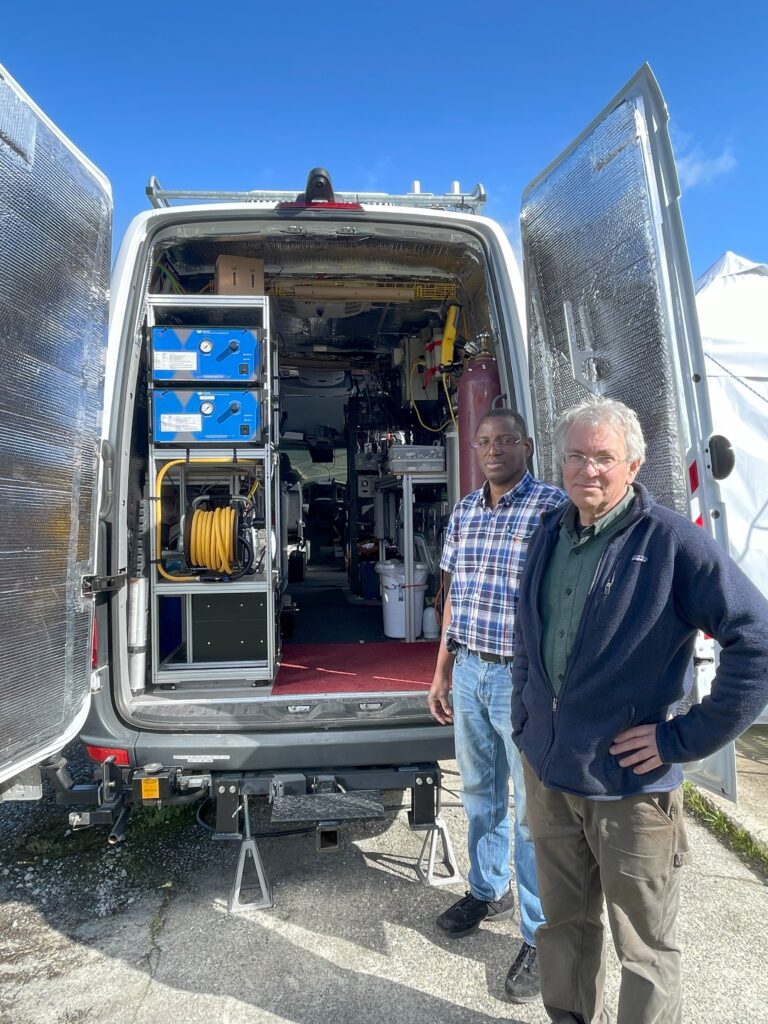
Washington State University researchers are working to fill in the missing data at a new experimental compost plant at the WSU Puyallup Research and Extension Center. The new facility is already yielding useful, real-time measurements.
“Other emissions studies have been done at a smaller scale in the lab, sometimes using as little as a few liters of compost,” said Tom Jobson, a professor in the Department of Civil and Environmental Engineering. “We needed something large enough to mimic the biological and chemical processes happening at actual composting sites.”
The new Puyallup facility handles about 50 tons of material, matching the size and shape of a commercial composting pile. At that scale, researchers can track emissions under realistic conditions.
Composting food waste is considered more environmentally friendly than disposing of it in a landfill, due to reduced emissions of methane, a potent greenhouse gas. However, composting generates another environmental concern: decreased air quality.
“It’s a story of public policy colliding with another piece of public policy,” said Jobson. “You don’t want food waste sitting in a landfill creating methane. But composting can release volatile organic compounds that contribute to ozone pollution.”
States like California have already flagged composting as a significant source of volatile organic compounds. As a result, commercial composters there now face stricter emission controls. Washington state, aiming to expand its own composting capacity, is trying to figure out if similar regulations are necessary.
“We’re in a discovery phase,” said Jobson, who is leading the $2.5 million research project. “We need real data about what’s actually being emitted before we know how or if we should regulate it the same way.”
To carry out that discovery, Jobson is working closely with WSU postdoctoral researcher Adeniyi Olufemi Adesina, the lead analytical chemist in the Laboratory for Atmospheric Research at the WSU Pullman campus.
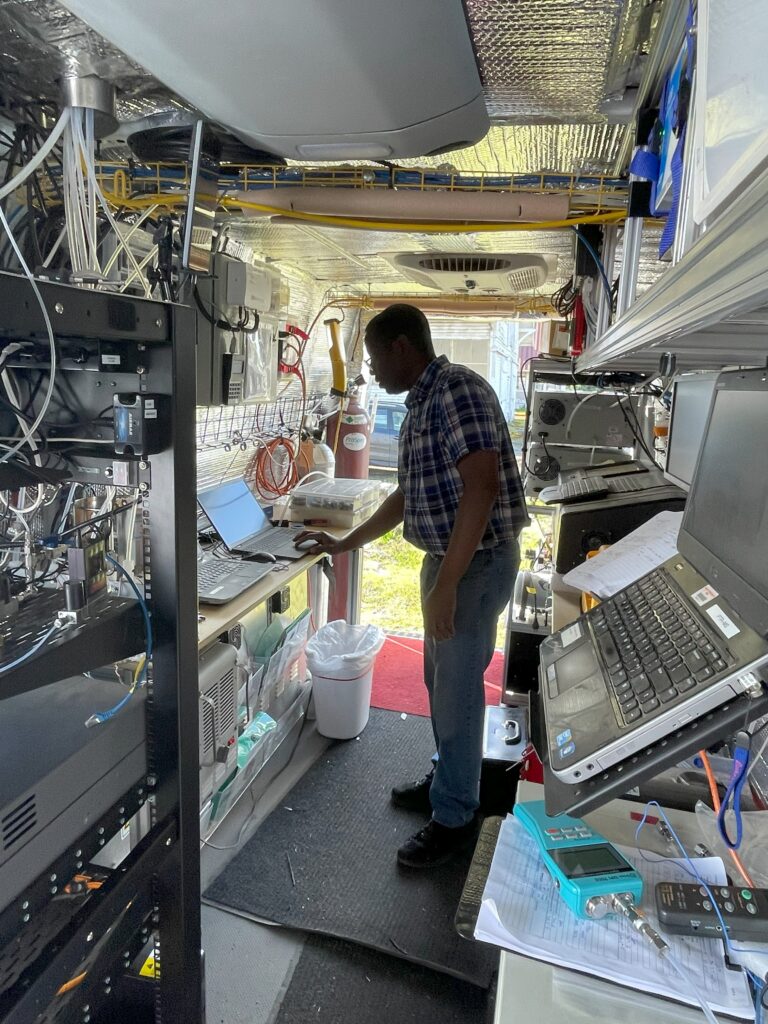
“We’re combining regulatory methods with real-time emission measurements in the field to get the clearest idea yet of what composting actually emits,” said Adesina. “Our research techniques are novel in that regard.”
With a completion deadline of June 30, WSU researchers are hard at work analyzing eight separate compost piles in quick succession. The compost facility has already generated a lot of compost, as well as real curiosity from those already working in the composting industry.
For Doug Collins, a WSU Extension soil scientist in Puyallup who was instrumental in siting and coordinating the project, the recent completion of the new research compost facility is already expanding that bridge between research and industrial enterprise.
“This state-of-the-art facility helps connect regulators and compost facility operators,” Collins said. “It gives both sides the data they need to expand composting applications without sacrificing air quality.”
Collins and other faculty at WSU Puyallup have collaborated with the Washington Organic Recycling Council to host the Compost Facility Operator Training for composters since the late 1990s. In October, the new Puyallup compost site will be incorporated into the Compost Facility Operator Training program, providing access to a unique research facility.
For Adesina, seeing the connection between science, government policy, and business has contributed to a profound learning experience.
“It’s not just science for the sake of science,” Adesina said. “We’re creating data that could shape public policy and industry practices for years to come.”
About CAHNRS
The land-grant mission of WSU’s College of Agricultural, Human, and Natural Resource Sciences is made possible through the U.S. Hatch Act of 1887 and the U.S. Smith-Lever Act of 1914. Respectively, these Acts fund experiment stations and cooperative Extension efforts that aid Northwest growers, provide nutrition and health education, support rural businesses, enhance our environment, and much more. Hatch and Smith-Lever capacity funds drive our work for a more resilient, prosperous, and sustainable Washington and are matched by state and local funds.
Media Contacts
Tom Jobson, Professor of Civil and Environmental Engineering, Voiland College of Engineering, Washington State University, Phone: 509-335-2692, Email: tjobson@wsu.edu
Doug Collins, Professor and Extension Soil Scientist, Puyallup Research and Extension Center, Washington State University, Phone: 253-445-4658, Email: dpcollins@wsu.edu