
Beekeepers whose first language is Spanish now have a knowledge resource for keeping pollinators healthy: the new Washington State University Abejas melíferas y polinizadoras website.
Educators with the WSU Honey Bee and Pollinators Program recently completed a full translation of the group’s English-language website, which covers everything from pests and diseases to training opportunities and the WSU bee blog.

“Right now, there’s a lack of adequate training resources for beekeepers in Spanish,” said Bri Price, a Puyallup, Washington-based Honey Bee Program Extension Coordinator for WSU. “That limits beekeepers’ abilities to make critical decisions that could enhance colony health and survival. Our new website, along with other projects, aims to fill that gap.”
Translation was funded by a grant from the USDA Agriculture and Food Research Initiative’s Critical Agriculture Research and Extension program and performed by Sandra Mina-Herrera, a doctoral student in the WSU College of Education, Sport, and Human Sciences who was raised in Colombia.
Before venturing into entomology for this project, Mina-Herrera translated between English and Spanish and taught in both languages, typically in the social sciences.
“I didn’t know anything about bees!” she said. Translation meant a deep dive into beekeeping and pollinator health, making the work a true learning experience.
“You need to know the context of what’s being presented and be curious about the topic,” Mina-Herrera said. “Otherwise, you might as well use whatever the dictionary or AI suggest, and that’s not ideal.”
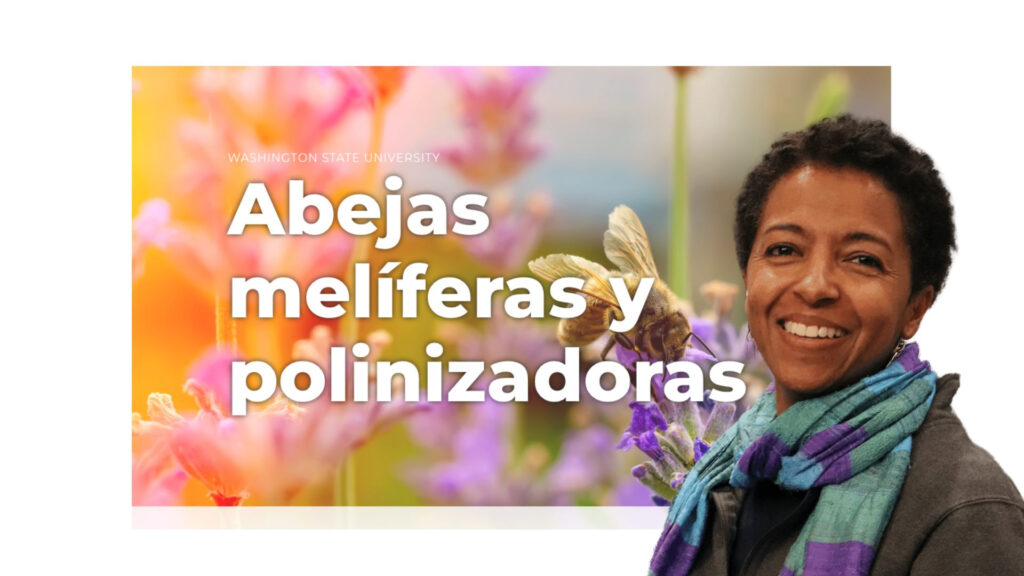
Indispensable aids included a large Spanish-language apiculture manual that Mina-Herrera calls her “beekeeping bible,” as well as bee websites from Spanish-speaking countries. As she translated, she frequently turned to Price for help with vital nuances, eventually making a personal connection with the small but crucial pollinators.
“This translation isn’t just for beekeepers and workers, but also for the bees,” she said. “The security of bees is important.”
Since launching in October, the site has seen more than 180 visits. The translation efforts are part of a broader plan to make WSU entomology resources more inclusive and accessible to a diverse public. The bee team is also posting Spanish-language YouTube videos on honey bee pests, translating WSU Extension publications on pollinators, and creating a professionally produced video series in Spanish for commercial beekeeper training. Rae Olsson, scholarly assistant professor in the Department of Entomology, oversees this wider project.
This year, Mina-Herrera will also translate educational materials for the Washington State Beekeepers Association’s Master Beekeeper curriculum.
“You can learn by doing, but when you understand the reasons why you do things, you’re empowered,” she said. “That’s the real impact.”
• Visit the Spanish-language site at https://abejas.wsu.edu/.