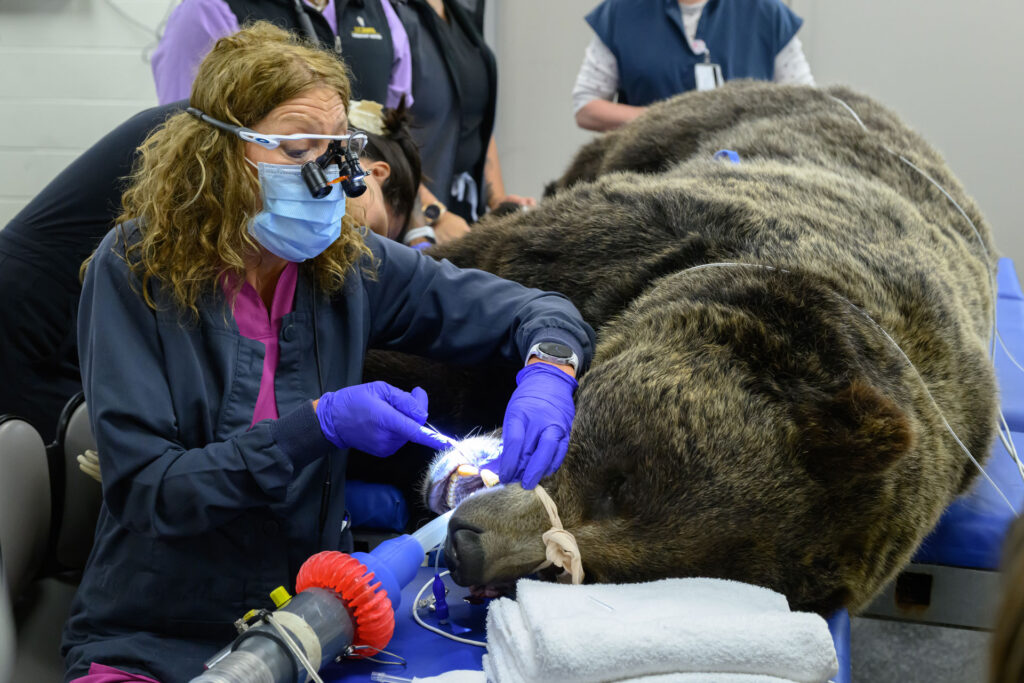
grizzly bear from the WSU Bear Center on Thursday, Aug. 20, 2026, at the Veterinary Teaching Hospital in Pullman.
(College of Veterinary Medicine/Ted S. Warren)
PULLMAN, Wash. — It turns out even bears need their teeth worked on from time to time.
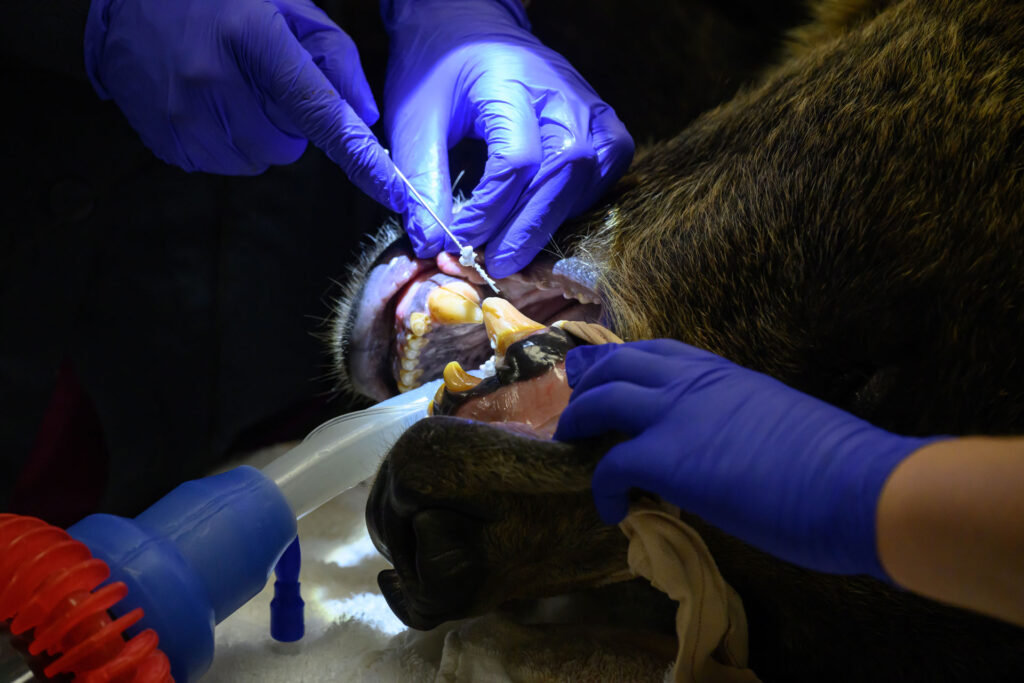
When Adak, a resident of Washington State University’s Bear Research, Education, and Conservation Center, recently damaged his canine tooth, the university’s vets stepped in to help the 11-year-old grizzly.
“We suspect Adak broke off the tip of his tooth while wrestling with his sister,” said Chelsea Davis, the Bear Center’s animal care facilities manager. “We recognized that this was a serious issue and immediately contacted the campus veterinarian.”
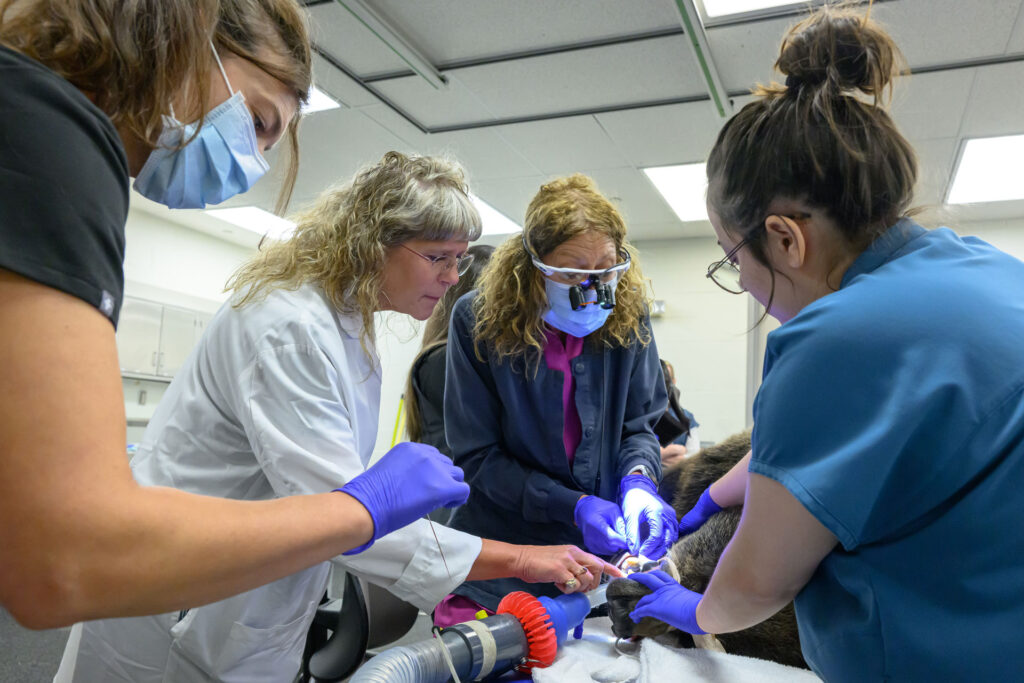
Fortunately, Adak was already scheduled for an anesthetic procedure the following day, allowing Davis to coordinate with Gay Lynn Clyde of Campus Veterinary Services to perform a more detailed examination of his tooth while he was under anesthesia. After seeing that the chipped tooth’s pulp was exposed, they quickly coordinated with the Veterinary Teaching Hospital and College of Veterinary Medicine Associate Dean and Professor Raelynn Farnsworth to schedule the grizzly for a root canal.
“A root canal is not something we can do at the Bear Center, so partnering with the vet hospital allows for better success of dentistry procedures,” Davis said. “Tooth issues are the number one health problem for bears. Behaviors such as sparring or chewing on enrichment items like bones and logs can cause wear and tear on our bears’ teeth. If we catch problems early, however, there’s a good chance of preserving the rest of the tooth and promoting better future health.”
Prior to the procedure, Davis and her colleagues prepped Adak by administering a pre-treatment medication and ensuring he was fasting.
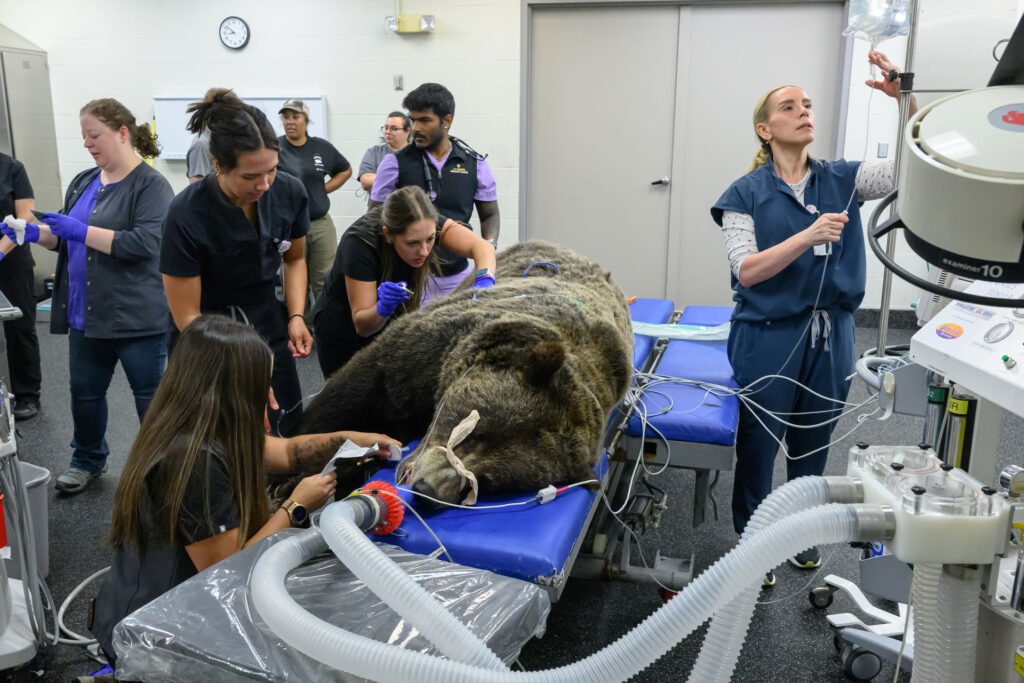
Then, the 500-pound animal was anesthetized and moved across campus to the Veterinary Teaching Hospital via an animal transport van. At that point, Davis handed the grizzly off to a group that included a boarded veterinary dentist; a boarded anesthesiologist; a fourth-year WSU vet student; Farnsworth; and several other graduate students.
“The vet hospital has always been great with our animals, and we trust them very much with their care,” Davis said.
After radiographing the tooth’s root, the vet med team numbed it and drilled a hole to access and clean out the live part containing the tooth’s nerves and blood supply. The next step involved sterilizing the root and inserting an inert substance into the root canal to prevent infection. After another radiograph confirmed that the tooth’s root was completely filled, the vets applied a filling to the hole they had drilled.
“We know the long-term oral health of bears affects many other things,” said Farnsworth, who teaches animal dentistry at WSU. “It impacts whether they’re eating properly, their appetite, and risk of infections. Luckily Adak’s tooth wasn’t infected, but we still took care of it as quickly as possible because we can’t just put the bears under anesthesia whenever we want to. It must be timed appropriately so they’re comfortable.”
The entire procedure took roughly two hours. Adak was given a long-lasting numbing medication to prevent pain during recovery, then staff transported him back to the Bear Center, where he woke up in the comfortable surroundings of his den. As part of routine care, he also received pain medication and antibiotics.
“This is a prime example of cross-college partnership at its best,” said Raj Khosla, Cashup Davis Family Endowed Dean of the College of Agricultural, Human, and Natural Resource Sciences. “The health and wellbeing of our bears is a priority, and I’m impressed with how the skilled Bear Center staff and College of Veterinary Medicine faculty worked together to ensure that Adak was as comfortable as possible while receiving expert care for his chipped tooth.”
While a tooth extraction usually means medication, continual follow-ups, and eight to 12 weeks of diet modifications, bears can immediately go back to their normal diets after a root canal, Davis said.
“The primary benefit of a root canal is that it allows us to preserve the tooth and maintain its function,” she added. “Whenever possible, we prefer to save the tooth rather than extract it. Preserving a functional tooth supports normal chewing and feeding and, in the long term, is better for the animal’s overall health.”
Davis and Farnsworth agree that the procedure also offered a special learning opportunity for WSU’s vet med students.
“It’s a win-win for everyone,” Farnsworth said. “We had a chance to perform a procedure we rarely perform, and Adak still has a functional tooth that supports normal bear behavior. It’s also beneficial for our students to see that vets aren’t going to be experts on everything. Collaboration is key to an animal receiving the best care.”
An audio-described version of this video is available here.
Media Contacts
- Chelsea Davis; Animal Care Facilities Manager at the WSU Bear Research, Education & Conservation Center; chelsea.davis@wsu.edu
- Raelynn Farnsworth; Professor and Associate Dean in the WSU College of Veterinary Medicine; raelynn@wsu.edu
- Angela Sams; College of Agricultural, Human, and Natural Resource Sciences Communications; alsams@wsu.edu