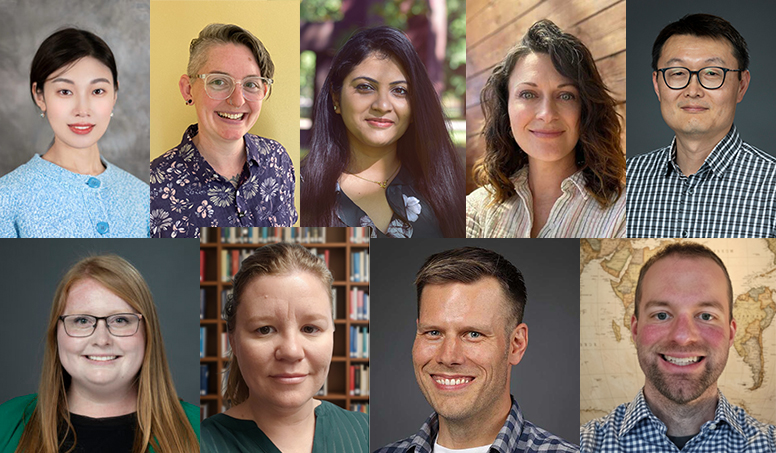
Nine scientists at Washington State University’s College of Agricultural, Human, and Natural Resource Sciences are launching high-impact educational experiences, research into complex challenges, and outreach that improves lives through a new fellowship program.
The Cashup Davis Dean’s Faculty Fellows program was created this year by Raj Khosla, Cashup Davis Family Endowed Dean of CAHNRS, to encourage bold approaches and cross-college collaborations.
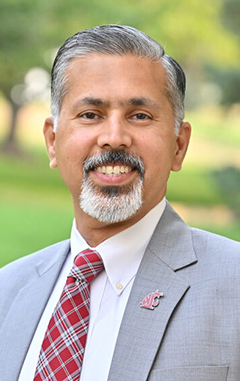
“Our strength has always been our people: faculty who are advancing discovery, transforming student learning, and delivering meaningful results across our state and beyond,” Khosla said. “This program is an intentional investment in that excellence.”
Totaling $65,000, the 2026-2027 fellowships range from outreach in youth wellbeing and pollinator health to development of educational opportunities and technologies that benefit agriculture, industry, and wildlife.
“The Cashup Fellow award is unique because it allows us to make an impact in areas of importance to many people in the Pacific Northwest that aren’t always supported by traditional funding sources,” said Michael Phelps, an award recipient and aquaculture scientist at WSU’s Department of Animal Sciences. “These projects will jump start whole new areas of impact.”
Awards include:
- Priya Chakrabarti Basu, Assistant Professor, Department of Entomology, $7,500 to launch the Apiary Action Plan, a statewide outreach project that expands youth beekeeping and supports veterinary training in honey bee health in partnership with clubs, beekeepers, and educators.
- Kimberly Davenport, Assistant Professor, Department of Animal Sciences, $2,500 to pilot a formal undergraduate research experience responding to current needs in animal agriculture, starting with sheep and cattle genetics.
- Ashley Hall, Extension Associate Professor and 4-H Youth Development Specialist, $2,500 to support a systematic evaluation of WSU C.A.R.E.S., or Collaborative Advocacy, Research, Education, and Support, a training program that addresses suicide prevention, mental health, and firearm safe storage in rural, Tribal, first responder, and military families and youth.
- Youngsoo Lee, Associate Professor, Biological Systems Engineering, $2,500 to help develop technology to create valuable products from waste generated by the dairy industry.
- Bryan Mader, Assistant Professor, Spokane County Extension, $10,000 to develop P.L.A.I.N. Health (Practical Literacy and A.I. Navigation), a suite of web applications that builds health literacy and helps Washington residents navigate AI and trusted sources to find safe, accurate, plain-language information for everyday health decisions.
- Rae Olsson, Scholarly Assistant Professor, Department of Entomology, $2,500 to help create a new forensic entomology lab that integrates research, teaching, and outreach, advancing our understanding of how insects colonize remains while training students for careers in criminal justice, life sciences, wildlife ecology, and other fields.
- Michael Phelps, Associate Professor, Department of Animal Sciences, $10,000 for Fish for the Future, a new citizen science initiative using AI tools and recreational angler involvement to improve Pacific Northwest fisheries.
- Alison White, Associate Professor, WSU Extension 4-H, $10,000 to support SPARKS Lab, a CAHNRS-connected learning program co-designed with local communities that engages youth in rural Yakima and Kittitas counties in exploring careers and designing and testing solutions to agricultural, human, and environmental challenges.
- Zihui Zhao, Teaching Assistant Professor, Department of Apparel, Merchandising, Design, and Textiles, $10,000 to establish KinetiKnit, a new digital knit fabrication and smart textile education program meant to train students to meet future industry needs.
Fellowships are named for James S. “Cashup” Davis, a 19th century pioneer and innovator who helped promote the Palouse region and is remembered for building a hotel atop Steptoe Butte. Cashup’s descendant, Gordon Davis, created the first endowed deanship at WSU, currently held by Khosla.
“Cashup’s vision challenges us to think beyond traditional boundaries and create opportunities for excellence, ambition, and innovation,” Khosla said. “The Cashup Davis Dean’s Faculty Fellows are ready to lead work that moves our college forward.”