A Washington State University Extension program is helping farmers and regulators work together to find pesticide solutions that safeguard both crops and salmon.
“We’re offering guidance on ways to balance the 2023 Endangered Species Act legal ruling while still managing pests in agricultural systems,” said Laura Lavine, chair of the Department of Entomology, which houses WSU Extension’s Pesticide Resources and Education Program. “It’s a story about efforts to conserve salmon while continuing to produce food.”
The breakthrough 2023 legal ruling created new requirements for evaluating pesticide impacts on endangered species and mandated more localized and habitat-specific application protocols. For many growers, the added pesticide application complexity is a major hurdle.
Pesticide labels may puzzle unfamiliar growers trying to navigate their use. Food producers often find themselves overwhelmed and frustrated.
“There has been this monumental shift lately in how pesticides are applied in Washington state,” said Wendy Sue Wheeler, director of the WSU Extension pesticide program. “Instead of simply reading the label and obtaining the proper licenses, you may need to visit a website, determine how much impact you’re going to have, and how you’re going to mitigate that impact.”
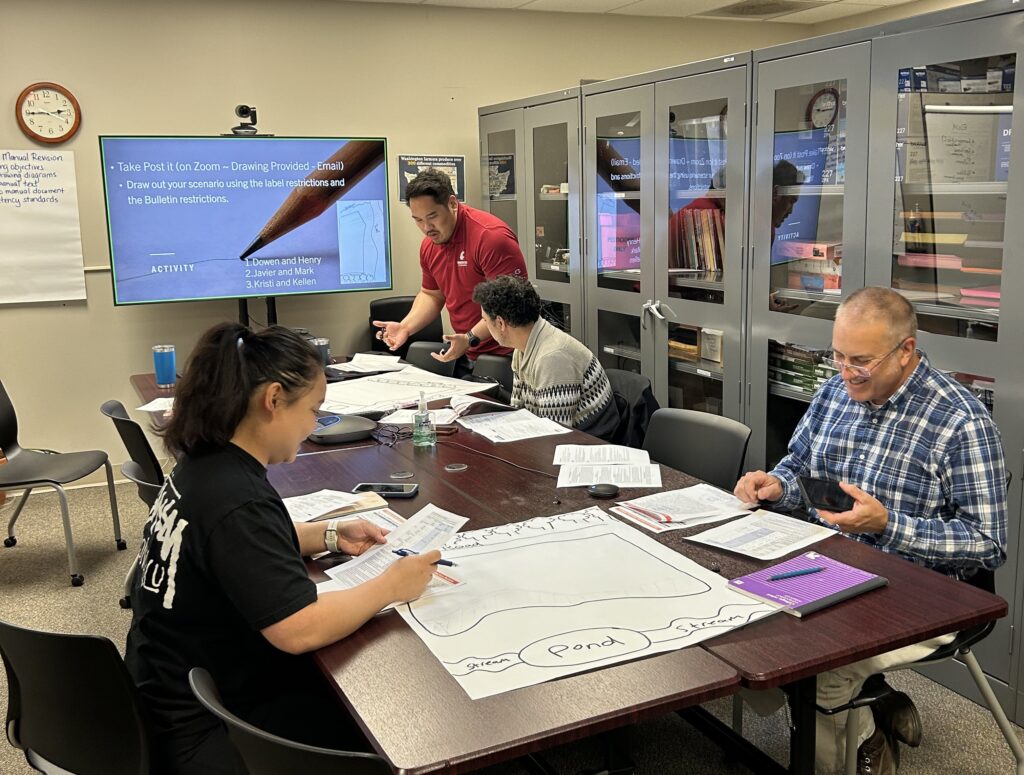
To address the confusion, Wheeler and her team held symposiums, convening farmers, conservation district and department of agriculture personnel, chemical company representatives, and others to review pesticide label differences and educate colleagues on recent legal developments. Analyzing pesticide labels collaboratively led to proposed avenues for safe application of chemicals near salmon habitat.
The conversations from these and similar events in 2024 resulted in a slate of recommendations to the U.S. Environmental Protection Agency, which enacted some of the suggested changes.
Lavine has been impressed with the high level of collaborations taking place among groups of people who don’t always see eye to eye.
“This is critical work,” Lavine said. “Deciphering the pesticide legalese and the pesticide label is almost impossible for one individual.”
In addition to hosting workshops and leading trainings, the WSU pesticide team reviews the pesticide recommendations in more than 5,000 WSU publications annually to ensure human and environmental safety.
“Their recommendations decrease risk of harm from pesticides through research-based guidance, not just for safety’s sake but to comply with legal and ethical standards,” she said. “This is Wendy’s long-term area of expertise — she can see the issue from the regulatory, environmental, and safety angles while ensuring compliance with the Endangered Species Act.”
It’s a tightrope walk between the two important, competing demands of conservation and food production, but Wheeler is heartened by the results she’s seen so far in 2025, including more collaboration between pesticide applicators and regulatory agencies.
“I’m driven to take on these challenges that seem impossible,” said Wheeler. “Helping applicators in Washington state to better protect vulnerable species and the food supply through education and collaboration is something I love doing.”
Further information
Whether it’s for protecting crops, managing garden weeds, or even stemming harmful invasive species, pesticide application is an often necessary and very common practice. Over 19,000 pesticides are listed in the WSU Pesticide Resources and Education Program’s searchable database that receives funding from Oregon Department of Agriculture, Oregon State University, the Washington State Department of Agriculture, and Washington State University.
If anyone in Washington is planning on using a pesticide, it is recommended to visit the database first and then to follow all pesticide label instructions.
About CAHNRS
The land-grant mission of WSU’s College of Agricultural, Human, and Natural Resource Sciences is made possible through the U.S. Hatch Act of 1887 and the U.S. Smith-Lever Act of 1914. Respectively, these Acts fund experiment stations and cooperative Extension efforts that aid Northwest growers, provide nutrition and health education, support rural businesses, enhance our environment, and much more. Hatch and Smith-Lever capacity funds drive our work for a more resilient, prosperous, and sustainable Washington and are matched by state and local funds.