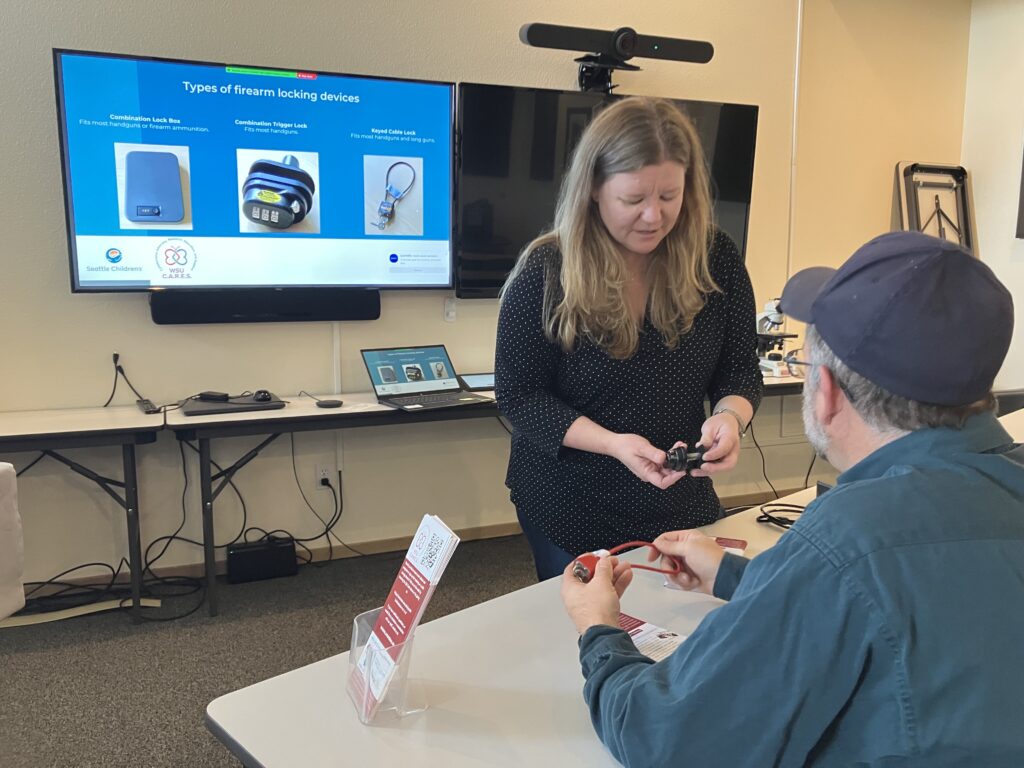
SNOHOMISH COUNTY, Wash. — Ashley Hall’s passion for her outreach work with Washington State University is driven by a desire to help others.
To recognize that dedication, the Washington State Healthcare Authority’s Division of Behavioral Health and Recovery (DBHR) recently honored Hall with the Prevention Award of Excellence. The award is given to individuals who are making exceptional impacts on their communities through substance abuse prevention, mental health promotion, and more.
“I’ve poured a lot of energy and passion into my prevention work, and I appreciate the recognition very much,” said Hall, a WSU Extension 4-H associate professor based in Snohomish County. “However, it’s impossible to do it alone. Our programs rely on community engagement and buy-in. Awards like these are invaluable because they bring attention to our work, emboldening and solidifying the legitimacy of what we do.”

Over the last several years, Hall has been instrumental in obtaining DBHR grant funding to support WSU Extension’s outreach efforts.
“Ashley has demonstrated how to successfully secure state funding for community-based Extension work related to prevention and mental health promotion,” said Associate Professor and Adolescent Extension Specialist Elizabeth Weybright, who nominated Hall for the award. “What she has done with that funding is equally impressive. I wanted to highlight her work because she deserves it, and it can serve as an example for others.”
Weybright believes that Hall’s position in WSU Extension gives her a real-world perspective that allows her to understand community needs, adding that Hall serves as a role model for how to successfully bridge the gap between academia and community partnership.
The WSU Extension Collaborative Advocacy, Research, Education, and Support (C.A.R.E.S) initiative is one example of that success. Established in 2022 as a suicide prevention program, C.A.R.E.S. collaborates with partners in Washington and beyond to engage in research, offer free suicide prevention trainings, and help teens provide outreach in their communities. Thanks to support from the Northwest Rural Opioid Technical Assistance Collaborative, C.A.R.E.S. also connects people in need with current mental health resources.
“It’s been fun to watch C.A.R.E.S. gain momentum as Ashley continuously brings on more partners and reaches additional audiences,” Weybright said.
Hall said her Extension role has helped her provide successful trainings and facilitate connections with those in need of support.
“Mental health is declining, and this was something I knew I could help alleviate,” she said. “Extension is an amazing system that has made it easy to reach out and impact different communities throughout the state.”
Hall points to her involvement as a 4-H Teens Helping Teens mentor as one of the most rewarding parts of her prevention work. An advocacy arm of WSU C.A.R.E.S., 4-H Teens Helping Teens is a youth-led committee that promotes mental health and human connection while raising awareness about suicide. The teens on the committee provide training to their peers, make presentations at conferences, and represent WSU C.A.R.E.S. at various tabling events, sharing information about suicide prevention and safe firearm storage.
“The initiative started out as a way to provide youth mental health first aid training to adults working with kids,” Hall said. “It has since grown into a comprehensive program where we provide Adult Mental Health First Aid as well as Teen Mental Health First Aid. Part of the reason we’ve been so successful is because the teens are part of the solution. They’re speaking for themselves, rather than adults speaking on their behalf.”
Weybright added that much of Hall’s success with the teens likely stems from her approach to actively engaging and establishing a true partnership with them.
“As adults, it’s easy to make assumptions about youth, and it can be challenging to step back and let them take the lead,” Weybright said. “Ashley approaches this work from a place of support, ensuring that the youth have a voice. Not everyone has that skill set.”
Hall is equally passionate about her firearm injury prevention work. As the WSU Extension 4-H shooting sports program coordinator, she is uniquely situated to make a meaningful impact by training shooting sports volunteers in suicide prevention and distributing firearm locking devices in the community.
“Ashley is someone I will always want to collaborate with,” Weybright said. “She consistently has good ideas, and she’s not afraid to speak up in a thoughtful, respectful, and inclusive way. She is a passionate and engaged partner who is trying to ensure that what we’re doing is feasible, acceptable, and ultimately successful.”