Behind each animal showcased at this year’s local county or state fair will be a human story of dedication, learning, and perseverance.
And the support of Washington State University Extension faculty, staff, and volunteers dedicated to educating on animal quality care, well-being, and biosecurity will be behind the success of many 4-H and FFA youth and adult animal exhibitions.
“We’re educating on the right production practices that take into account animal welfare and the safety of food animal products being produced, whether meat, milk, or eggs,” said Paul Kuber, WSU Extension livestock and 4-H specialist. “We’re focused on helping people develop animal care skills while protecting the food supply.”
Kuber has served on the Washington State Department of Agriculture Fairs Commission since 2021 and currently leads over half-a-million dollars in USDA grants focused on developing resources that educate adults in the fairs industry about disease mitigation through best care practices to assure livestock well-being as well as biosecurity at fairs.
“When we give people the education to develop critical thinking, responsibility, and compassion while raising an animal, whether 4-H, FFA, or adult participants, there’s a lifelong benefit to the person and the animal,” said Kuber. “They learn to apply and comprehend animal care practices that many of them will use for decades to come.”
No stranger to livestock management, Kuber has been involved in youth food animal quality assurance programming since 2004, first with Ohio State University and then with the National Pork Board Youth Pork Quality Assurance-Plus program.
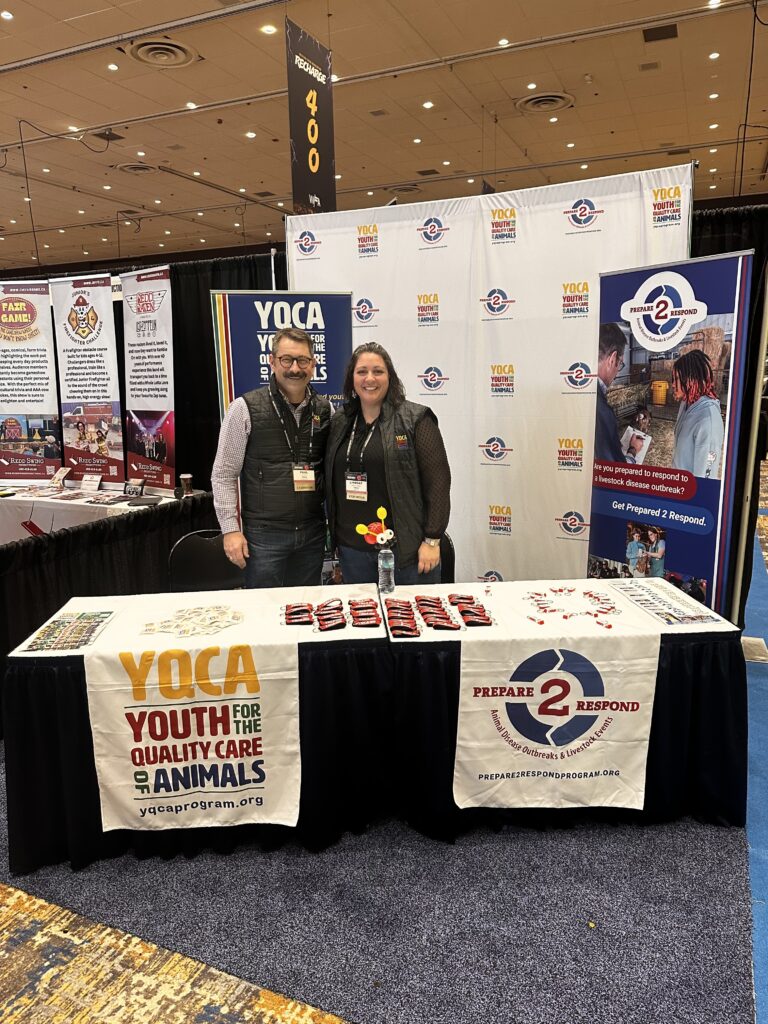
In 2013, Kuber and numerous colleges across the U.S. began the development of what is known today as the Youth for the Quality Care of Animals (YQCA) program. From grassroots beginnings the nationally recognized, multi-species YQCA program grew and has surpassed over 600,000 certifications since its launch in 2017. Nearly all who take the training are enrolled in either 4-H or FFA.
Last year, Washington state was in the top 10 for number of YQCA certifications. Nationally YQCA broke its all-time-high record and reported over 100,000 certifications in a single year.
“If these participants pursue livestock production as a career, this training provides them with tools that they’ll need to be successful.” Kuber said. “If those who take the training choose not to pursue livestock production, then they’ll still be smarter consumers who know more about the food supply and quality food production practices.”
The curriculum has broad support from the food animal industry and is recognized as an equivalent to adult quality assurance programs offered by industry commodity groups. The federal government also supports YQCA as a qualification for export trade.
Kuber’s latest efforts include Prepare2Respond, a YQCA offshoot that he is spearheading through a multistate Extension effort led by WSU. The USDA-backed program, which began in 2020 and will expand in 2026, is geared toward adults in the fair industry and teaches disease mitigation practices and fair biosecurity.
“Because of the dynamic environment of fairs, including the transient populations of animals and people, disease can spread exponentially,” Kuber said. “Prepare2Respond aims to prevent outbreaks and provide concrete steps to take if one occurs.”
The USDA funding supports Prepare2Respond’s tabletop exercises and outbreak scenario-based learning, which uses examples like highly pathogenic avian influenza, swine influenza, and foot and mouth disease to teach proper disease mitigation for fairs and exhibitions. Kuber hopes to roll out updated learning modules this summer, with plans to expand them nationally and internationally over the next two years.
The YQCA and Prepare2Respond programs are great examples of the behind-the-scenes support that WSU provides to county fairs across the state, said Mark Heitstuman, interim WSU 4-H director.
“WSU faculty and staff play a pivotal role in identifying and training the volunteers and superintendents who put on these county fairs,” Heitstuman said. “And the local 4-H Extension office volunteers, faculty, and staff are also hard at work supporting the youth who showcase their animal projects.”
It’s a once-a-year chance for 4-H youth to demonstrate the fruits of their labor and learning, an experience that culminates in a hubbub of people excited to see the many animals on display under tent canopies, trotting in dirt arenas, or lounging in straw.
“These 4-H and FFA projects are important,” Heitstuman said. “They instill a self-confidence that comes from hard work and perseverance, ultimately benefiting youth in the short- and long-term.”
Learn more about WSU 4-H
Washington State University 4-H empowers youth to reach their goals while working and learning in partnership with caring adult volunteers and mentors. WSU 4-H is committed to helping young people become productive citizens who are engaged in positive change, meeting the needs of a diverse and changing society and contributing to thriving, healthy communities, families, and individuals.
Media contacts
Paul Kuber, Associate Professor and Regional Livestock and Forage Extension Specialist, Phone: 509-477-2185, Email: pskuber@wsu.edu.
Mark Heitstuman, Associate Professor and Interim Washington State 4-H Program Director, Phone: 509-243-2009, Email: heitstuman@wsu.edu