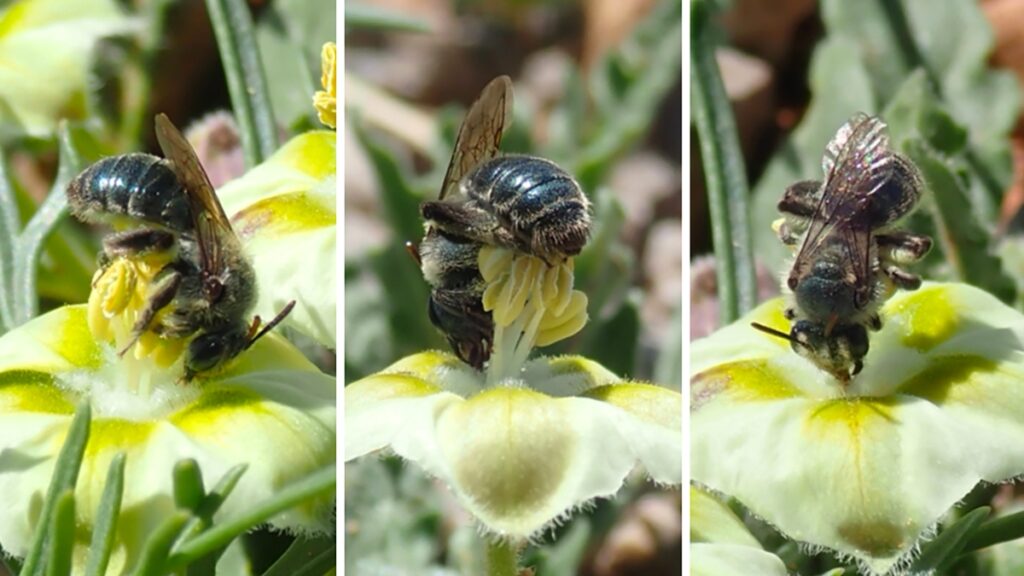
Scientists at the University of Oklahoma, Washington State University, and the Central Texas Melittological Institute have discovered and named a new species of mining bee, sharing their work in the journal Ecology and Evolution.
The newly discovered species, Andrena androfovea, has been documented interacting with plants in the wild in Oklahoma and Texas, and researchers have now sequenced its genome.
“The process of documenting bee biodiversity started centuries ago, but scientists are still discovering new species all the time,” said James Hung, University of Oklahoma assistant professor of biology and co-author of the paper.
As much as 85% of all flowering plants on Earth require animal pollinators to survive and reproduce. Bees are the most important members of this group, especially in temperate ecosystems.
Bees in the Andrena genus are commonly known as mining bees, thanks to their ground nesting habits. There are over 1,500 species of Andrena bees in the world, making it one of the largest genera of animals on the planet.
However, this newly discovered species does not fit into any of the existing 104 subgenera of Andrena. That means it is not closely related to any Andrena bees discovered thus far, making this a significant discovery.

“This new species is so distantly related to any other Andrena that we think it has formed its own branch on the Andrena family tree about 12.6 million years ago,” said Silas Bossert, co-author and assistant professor at WSU. “We know this because we compared its genome to those of other bees.”
Using a technique called a ‘molecular clock,’ scientists can approximate how much time has passed since the lineage has separated from the other bees based on differences in its genome, Bossert added.
According to Hung, creating a new bee subgenus is rare in recent decades, and even more uncommon when a new species is discovered. Typically, new subgenera are created due to rearrangement.
Co-author John Neff collected this bee in Texas for several years before confirming its unique position in the Andrena genealogy. During recent discussions, Hung and Neff spoke with Bossert, a molecular systematist who uses DNA to reveal the deep branches of the evolutionary history of bees. The three quickly realized that they were talking about the same bee and knew they had found something special.
This newly discovered bee is the only species in the genus Andrena that has an affinity to plants in the tomato family.
Read the full story of the discovery at the University of Oklahoma news website.