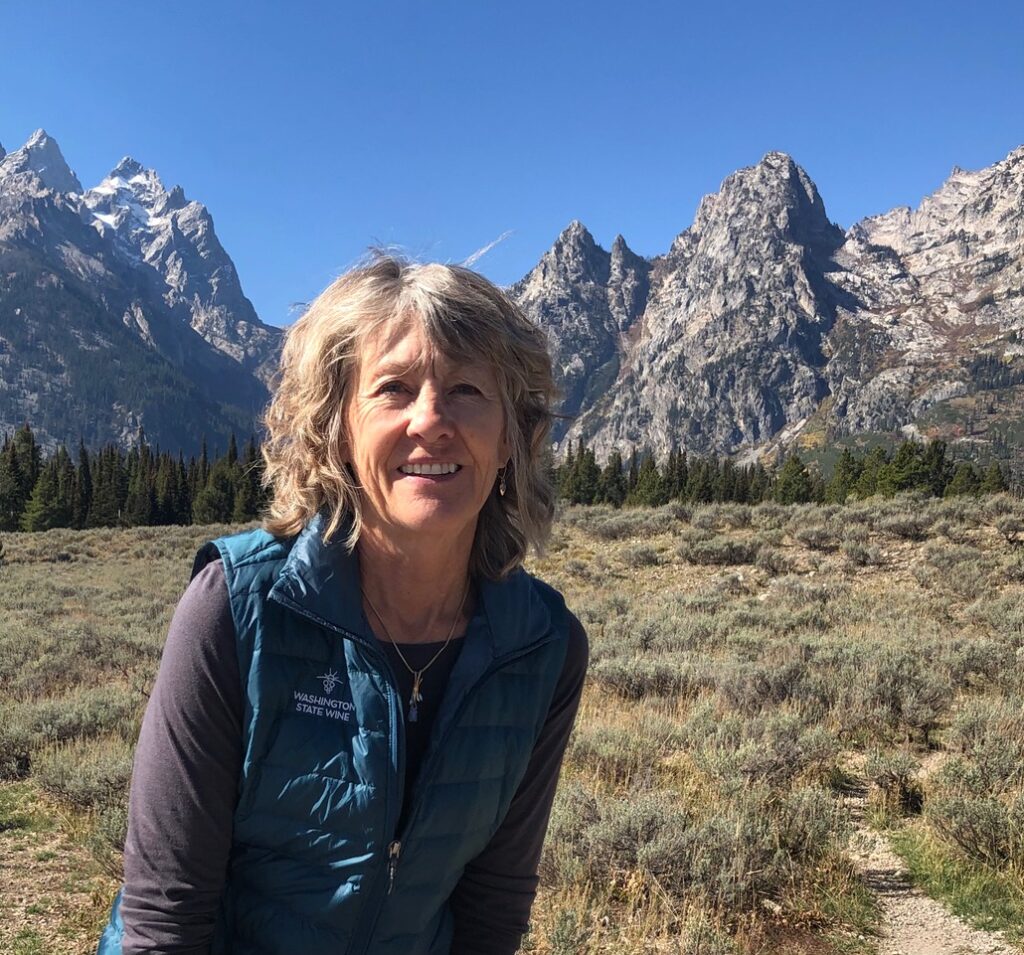
RICHLAND, Wash. — Since joining the Washington State Wine Commission (WSWC) as its research program director a decade ago, Melissa Hansen’s goal has remained the same: to foster a connection between Washington State University scientists and the wine industry.
“My focus has been finding tangible industry solutions by asking, ‘What’s in this for the grower?’ or ‘What are the applicable research takeaways?’” Hansen said. “I’m also an advocate for WSU. I want to solve these problems as much as the scientists and help them secure the industry funding needed to do so.”
Hansen officially retired at the end of 2025, with Julie Tarara, a former USDA research scientist and Ste. Michelle Wine Estates viticulturist, taking over the role.
“Melissa has been an extraordinary partner to WSU and an unwavering champion of the Washington wine industry,” said WSU Viticulture & Enology (V&E) Department Chair Jean Dodson Peterson. “Throughout her career, she has helped strengthen the connection between the industry and WSU V&E by consistently elevating research, people, and education. Melissa’s collaboration has helped build trust, visibility, and shared purpose across our programs. Her impact on our department and the industry more broadly will be felt for many years.”
When asked what she will miss most about her role, Hansen is quick to answer: the people. She points to her physical presence at the Ste. Michelle Wine Estates WSU Wine Science Center as key to truly understanding researchers’ challenges.
“The WSU V&E department is like my family,” she said. “Having an office on campus and hearing scientists’ pain points helped me design modifications that made our grant program more streamlined. My goal was to help the researchers focus on their work as much as possible.”
Hansen has shepherded more than 200 research requests to the Wine Research Advisory Committee (a WSWC subcommittee) over the last decade, with most of those requests going on to receive funding. She has been heavily involved in WSU’s grape smoke exposure research, helping secure USDA funding for the university’s scientists.
“What I’m most proud of is the accessibility of these scientific studies,” Hansen said. “Anyone can visit the WSWC website to read a research report or watch a webinar and learn about Washington’s cutting-edge, innovative research.”
Hansen has represented the Washington wine industry on a variety of national boards. She has also established connections with the National Grape Research Alliance and the West Coast Smoke Exposure Task Force. In 2022, the Washington State Grape Society recognized Hansen’s dedication to the industry with the Walter Clore Award.
Originally from California, Hansen comes from a farming background. She earned her bachelor’s degree in agriculture journalism at California Polytechnic State University.
“Studying journalism helped me learn how to ask questions,” Hansen said. “I wasn’t afraid to say, ‘This sounds like a well written proposal, but what will the grower get out of it?’ or ‘What can a winery do with this information?’ If a researcher could convince me that their work matters, then I could help convince the Wine Research Advisory Committee to support it.”
Prior to joining the WSWC, Hansen spent time working at the Council of California Growers, the California Grape and Tree Fruit League, and the California Table Grape Commission, where she served as research director.
In 1995, Hansen and her husband purchased a farm in Ellensburg, Washington, moving to the area just as the state’s wine and grape industry was taking off. She spent the next 20 years working for Good Fruit Grower, developing close relationships with WSU V&E scientists while covering grape research for the magazine. WSWC hired her as its research director in 2015.
Though the Washington wine industry has experienced challenges in recent years — including a reduced research budget and federal funding uncertainty — Hansen hasn’t deviated from promoting the work of WSU scientists.
“Efficiency is key,” Hansen said. “With fewer dollars to spend, it’s necessary to pinpoint what research will make a difference for the industry. One silver lining is that this will hopefully foster an even stronger collaboration between researchers in Washington, Oregon, and California.”
Hansen is kicking off her retirement with a trip to Costa Rica and plans to spend more time with her grandchildren, who live out of state. Though she will miss her role with the commission, she knows she has helped build a solid foundation for future success.
“Creating this research program was truly a team effort,” Hansen said. “The Washington wine industry should be proud of everything it has accomplished. Not many wine regions support research like our state does, but we have created a program that’s nimble, responsive, and guided by industry.”
Voice of the Vine
Subscribe to the Voice of the Vine newsletter for stories about the latest emerging research from WSU’s Department of Viticulture and Enology, profiles of students, alumni, and researchers working in Washington’s world-class wine industry, info on upcoming events, and much more.