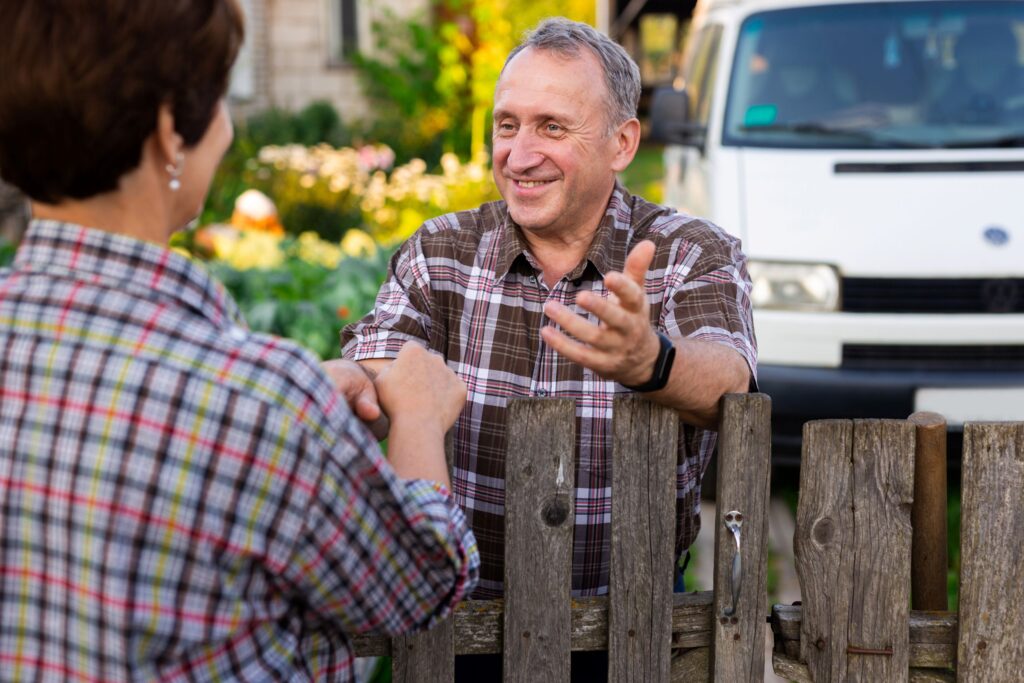
BLAINE, Wash. — By sharing food or checking in on someone close, neighbors can help spread cheer this season, and, with practice, build a habit that supports community and personal well-being.
Interactions across the property fence line are a predictor of health, according to ongoing research from Washington State University Extension.
“From a prevention science standpoint, good-neighbor strategies tend to mitigate many health problems at once,” said Shawna Beese, WSU assistant professor of rural health promotion. “Your neighborhood is where you spend the majority of time, and it’s become clear that social support, safety, and cohesion are major health outcome factors.”
Current research from the Community Health Oriented Resilience Data Science (CHORDS) Lab at WSU Whatcom County Extension suggests that being a good neighbor can decrease both stress and chronic disease development while increasing community cooperation.
According to a 2023 U.S. Surgeon General report, only three in 10 Americans know their neighbors. It’s part of an evolution described in the book “Bowling Alone” as an epidemic of loneliness and isolation in America. According to the book, neighborly civic engagement peaked in the 1950s and ’60s.
“In my research, I heard a lot of people saying, ‘Remember how we used to know our neighbors?’ Post-pandemic, not knowing your neighbor felt like a real gap,” Beese said.
CHORDS lab research is providing the momentum for current WSU Extension programming in the northwestern Washington city of Blaine. This past year, CHORDS Lab Researcher and Extension Specialist Kristen Barta focused on building awareness surrounding the health outcomes that come from high levels of neighborhood trust and solidarity.
“When you intentionally practice being a good neighbor, you’re exercising a muscle for social connection and trust,” Barta said. “Good neighboring has been shown to boost health at the individual level as well as community cohesion.”
Inspired by the WSU findings and outreach, city officials in Blaine issued a proclamation naming Sept. 28 “Good Neighbor Day.”
“There’s so much grassroots interest,” said Barta. “We’ve already seen tightening community connections, new neighborhood initiatives, and partnerships that better leverage resources to support more of the community.”
CHORDS community classes include Neighborhood Prevention Science 101 and Neighboring as a Health Promotion Strategy, which are part of a bigger six-course collaboration offered through WSU Extension in partnership with the Washington State Public Health Association.
Beese said these partnerships and outreach have yielded new strategies for good neighboring.
“Part of that can be as simple as spending more time on the front porch to make yourself available, then building involvement from there,” she said. “It might not seem like much, but to the youth, caregivers, and older adults who spend more time at home on average, small gestures open the door for meaningful connection.”
Further information
Those interested can commit to the One Year of Good Neighboring plan as an enriching New Year’s goal. Or visit the CHORDS Laboratory website to learn more.
Media contact
Shawna Beese, Assistant Professor of Rural Health Promotion, email: shawna.beese@wsu.edu, phone: 509.844.4729