HARRINGTON, Wash. — Thanks to the support of Washington State University Extension’s Energy Program, the Harrington School District is the first in the state to benefit from The Giving Grid, which offers solar panel installation for qualifying school districts at no upfront cost.
WSU Extension is providing the technical guidance while administering Washington’s Community Solar Expansion Program, which helps rural districts turn solar proposals into reality. A collaboration of nonprofit and private partners, The Giving Grid spearheads the delivery of the turnkey solar services to help districts access state funding.
Mike Gaffney, associate director of WSU Extension, said the project demonstrates the university’s commitment to pursuing innovative, sustainable solutions for rural communities across the state.
“Rural school districts often lack the resources to fund important and meaningful programs, or to support students in need. This project will generate energy savings which can be used to meet those needs,” he said. “In addition to the savings, having solar capacity increases the school’s resilience — both for operations and in its role as a community center.”
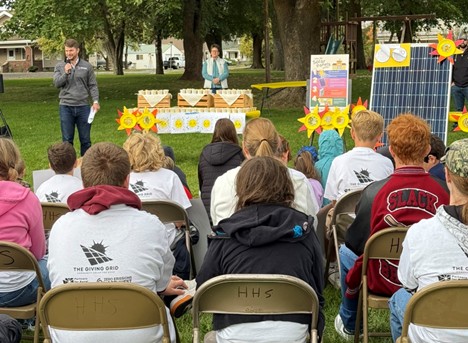
The school district celebrated the solar project’s completion with a ribbon-cutting ceremony at Harrington City Park in early October.
The event featured music from the Harrington School Band and drew the entire K-12 school — nearly 150 Harrington students and family members — to celebrate a new chapter in the district’s energy savings and a step toward a more sustainable footprint.
“This project is about resilience, education, and opportunity,” said David Funk, president of Zero Emissions Northwest, the company that completes the installation. “The Giving Grid empowers rural schools to take control of their energy savings while supporting students and communities.”
The Harrington solar installation is expected to reduce the district’s annual utility costs by approximately $15,000, with an estimated 30-year savings of close to $1 million. Those savings for the first 10 years will be directed toward programs that support low-income students.
Many of the school districts within The Giving Grid program will use their utility cost savings to support low-income students through STEM education, after-school enrichment opportunities, or mobile health clinics for those with limited access — a critical service in rural areas.
“The Giving Grid aligns closely with our mission to strengthen rural communities through innovation and sustainability,” said Jody Opheim, director of Partners for Rural Washington. “Healthy, resilient schools are at the center of thriving rural areas.”
Building on Harrington’s success, The Giving Grid has 22 other school district projects planned for 2026.
“We’re proud to be the first in the state, but we won’t be the last,” said Courtney Strozyk, superintendent of the Harrington School District. “This shows what’s possible when communities and educators come together with shared purpose.”