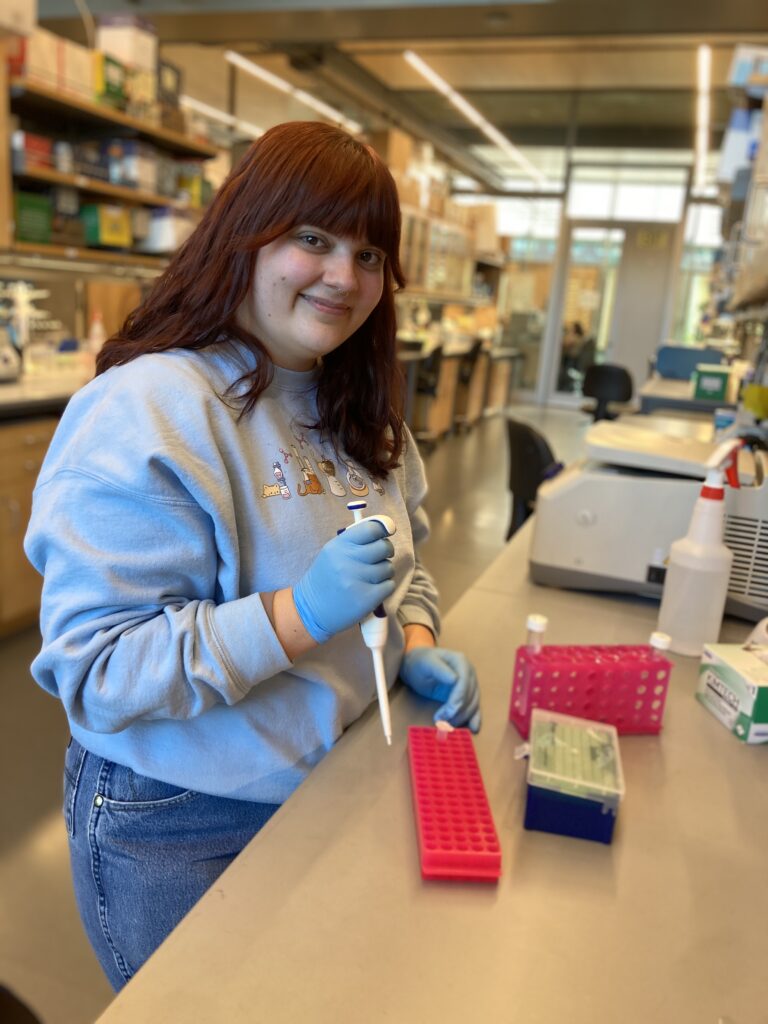
As a first-year student just beginning her college adventure at Washington State University, Jocelynn Brown took a leap and started her own scientific research project.
Through the CAHNRS Ignite Top Scholars undergraduate research program, Brown joined the newly founded lab of animal scientist Kim Davenport and began sleuthing for DNA clues that could solve fertility challenges in cattle and humans.
Flash forward two years, and Brown, now a junior, helps inspire incoming first-year students to go hands-on with science and shares her work with international peers.
“Undergraduate research through Ignite helped me grow and made me more outgoing.” Brown said. “It made me realize that science is something I enjoy and want to pursue as a career.”
Helping animals and people
The livelihoods of dairies and cattle producers depend on healthy mothers and calves. Fertility is a major economic and animal welfare concern, and pregnancy losses can signal hidden problems like malnutrition, infection, or heat stress.
Brown’s research project involves sequencing RNA from individual cells and comparing immune cells from cattle and humans to find the genetics underlying immune-related pregnancy loss.
“There’s a gap in our knowledge when it comes to animal fertility,” she said. “There’s still a lot we don’t know about how immune cells cause fertility problems.”
Brown’s discoveries could ultimately unlock new therapies for disorders like preeclampsia, a serious, sometimes fatal hypertension that occurs during pregnancy.
She is also contributing to research on the genetic markers responsible for a desirable wool color in sheep. The experiences have trained her in a range of advanced laboratory tools and techniques and instilled an interest in science as a career.
For Davenport, Brown is an asset to the lab.
“Jocelynn often steps in to help troubleshoot experiments or guide new students, which really adds to the sense of community and teamwork in the lab,” the assistant professor said. “She contributes greatly, not only through the quality of her research, but also by fostering a collaborative and supportive environment. I am excited about her future in science.”
Drawn to research
Brown’s interest in animal science began as a teen back home in Surprise, Arizona, when she took a sick pet to the local veterinarian.
“That was something I could see myself doing,” she said. Exploring college options, she toured WSU after learning about its accelerated honors program.
“I fell in love with the campus and the people,” Brown said. “This was exactly where I wanted to go and what I wanted to do.”
Around the time she was accepted, Brown opened an email promoting the Ignite undergraduate research program in CAHNRS. She wasn’t sure she could balance research, academics, and college life as a first-year, but her mom encouraged her to seize the opportunity.
Brown signed up but still wasn’t sure about attending the first Ignite meeting alone. A WSU friend agreed to accompany her. Off they went, and both became undergraduate researchers through the program.
Brown chose Davenport’s lab because she connected with the scientist and liked the friendly atmosphere. Student researchers typically work with graduate-student mentors as part of the senior students’ projects. But with Davenport herself a recent arrival and her lab newly launched, Brown could start her own project.
“That first year was very much a learning experience,” she said. “I was mastering the basics and learning to code.”
As she progressed, Brown gained more responsibilities and mastered tools and techniques, like analyzing DNA. She later became a mentor to other undergraduate researchers entering the Davenport lab.
At Top Scholars orientation events, Brown can be found answering questions and showing new students the ropes.
“I know how scary it can be to get started,” she said. “You don’t know what you’re supposed to do yet. I try to ease the anxiety and lighten the atmosphere — that makes students more willing to step out of their shells and ask questions.”
One of her most meaningful research moments came this January, when Brown traveled to San Diego for the International Plant and Animal Genome Conference, benefiting from the George & Jean Fries Undergraduate Research Travel Award in Animal Sciences as well as an Honors College award to make the trip. She presented a research poster and was highlighted as part of an invite-only workshop.
“It was an astounding experience,” said Brown, who displayed her poster alongside hundreds of other scholars.
Scientists approached Brown and Davenport following the workshop, and Brown helped her lab leader field curious questions.
“Representing my work and poster was so helpful in confirming I am on the right path,” she said. “This is something I am very interested in and want to study for myself.”