WSU weather prediction service saves farmers millions
One evening last spring, Garrett Henry checked WSU’s AgWeatherNet (AWN) system and saw predicted low temperatures of around 26 degrees.
As an area manager at the Douglas Fruit Co., Henry knows that low spring temperatures can cause major damage. While 26 degrees alone is unlikely to be problematic, the 13 degree dew point prediction was more concerning.
“Seeing the dew point prediction, we knew we had to adjust our plans,” Henry said. “We started our frost control water when temperatures hit 40 degrees, which saved our crop.”
A low dew point in cold weather means there is very little moisture in the air, so buds quickly freeze above what is considered normal threshold temperatures. Early watering helps add moisture to the air. If irrigation is sufficient, a more humid microclimate is created around buds and flowers, essentially insulating them from frost and the resulting damage.
The effect was illustrated on one of the company’s orchard blocks, which was split by a road. One half had water and saw no damage. The other half, without water, experienced a 40% loss.
“I know people who lost their entire year’s cherry crop that night,” Henry said. “AgWeatherNet is critical for us. You get so used to having something that you don’t know how much you rely on it until you think about those impacts.”
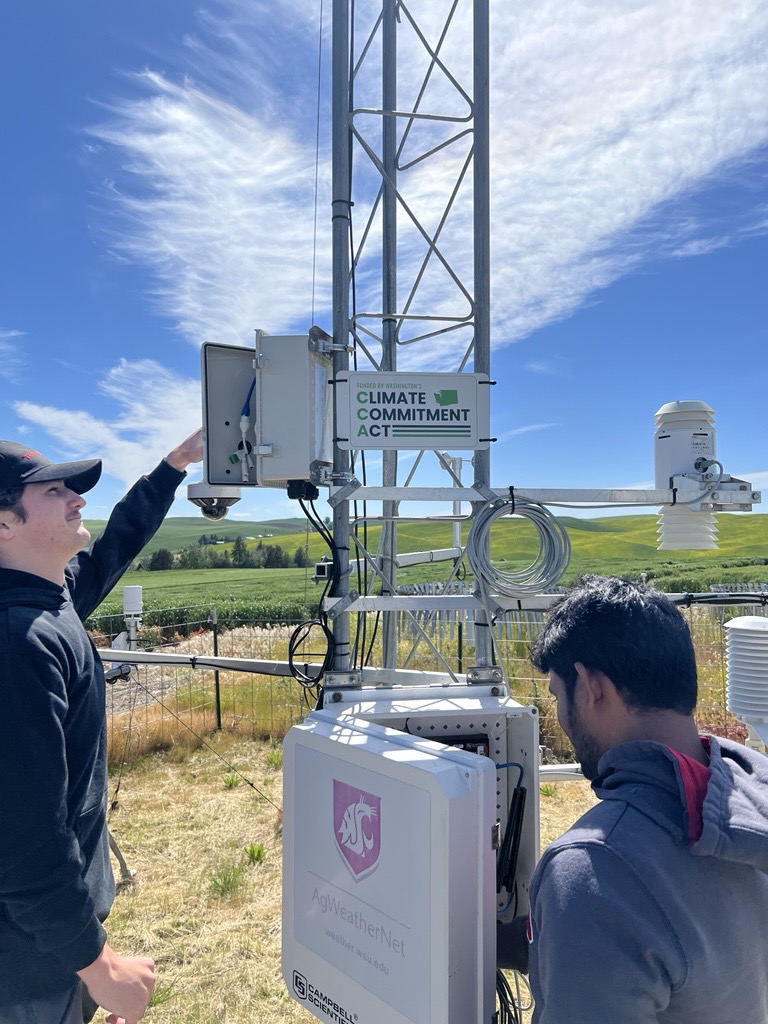
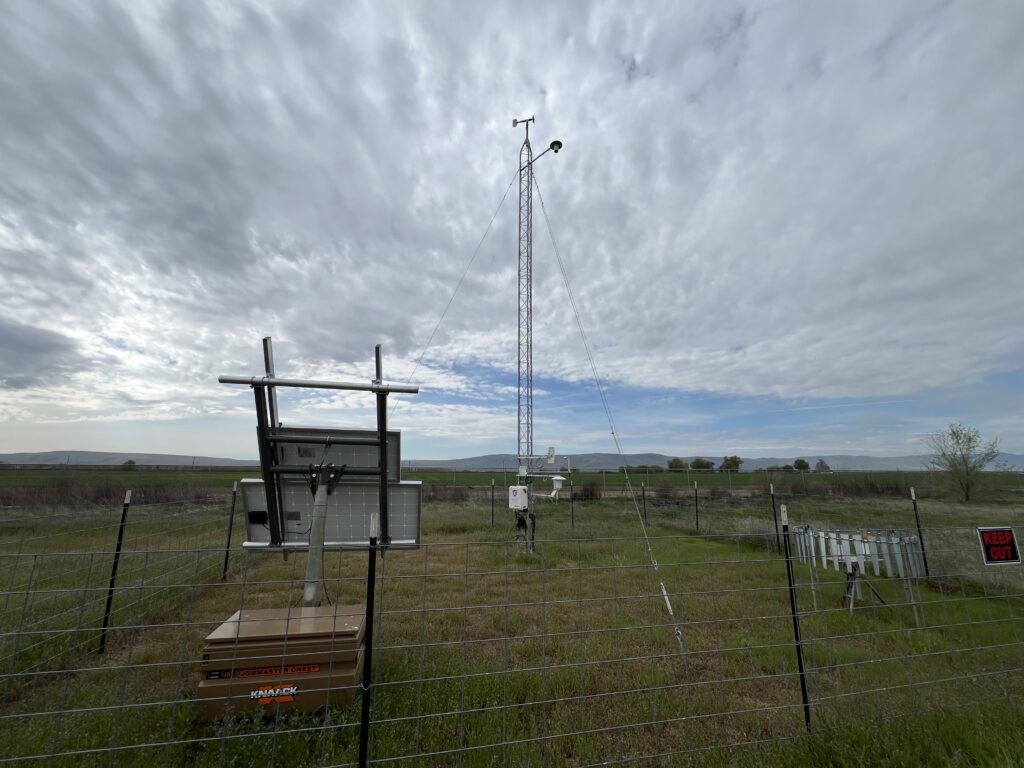
AWN has been serving the Washington agriculture industry for 40 years, hitting 14.8 million page views in 2025. The system currently sends data from 370 weather stations around the state.
“We are very focused on the end users of our data, models, and creating more accessible ways to provide data to help crop, human, and animal health systems,” said Lav Khot, AWN director and a professor in WSU’s Department of Biological Systems Engineering. “People use our data year-round; the National Weather Service uses it for forecasts. Our users are growers and farmers on small, medium, and large farms who raise blueberries, grapes, tree fruit, cattle, and much more.”
Weather forecasting and modeling stressors are key aspects of AWN, helping growers make management changes proactively. That includes the spring frost forecast that helped Henry.
“We’re forecasting for millions of dollars of crops,” said Josh Ward, an AWN field meteorologist. “It weighs on you to know that if you get something wrong it could cost someone hundreds of thousands of dollars. I focus on how much we can help, which feels great. It makes me feel like we’re contributing to people’s lives.”
Julie Tarara is another person who has relied on AWN to help her crop. A viticulturist, or grape grower, Tarara used AWN data year-round.
“Knowing how low temperatures will drop in winter is important for cold hardiness and looking for damage. The data also helps when watching for frost in spring and excessive heat that impacts berries in summer. There is always something to watch out for,” said Tarara, who worked for a large winery, then a vineyard management company, after spending 15 years as a USDA scientist. “If you can’t capture relevant information, you can’t manage your crop as well.”
Now serving as the research manager for the Washington State Wine Commission, Tarara said she has a more casual interest in AWN. But she remains impressed with its capabilities and progression over time.
“As computing advances, so has AgWeatherNet,” she said. “I attended a session this summer where they showed off a new heat tool. It’s been a phenomenal evolution.”
AWN also impacts pest management, cattle, and humans. The network offers inversion forecasts that help growers decide whether spraying would be useful or wasteful, for example. In the summer, the team produces heat stress measurements and forecasts for both humans and cattle.
“Cattle ranchers use our portal to measure what cows feel,” Ward said. “That helps them make decisions on the animals’ safety and when and what to feed them.”
Ward said the general population can also access useful weather information. He produces a weekly forecast for the entire state that is broken down into five regions. It also includes an extended outlook. A new AWN app, launched this past spring, has farmer-specific data, forecasts, and hindcasts, as well as useful information for the non-agriculture population.
“We’ve been installing air quality monitors at all of our advanced weather stations around the state,” Khot said. “They automatically provide hard data to any Washingtonian from their nearest AWN station.”
Statewide data is updated every five minutes, around the clock, Ward said.
“The commercial weather apps most people use on their phones are based on modeling, not localized data,” he said. “Our network provides real-time information across the entire state. It’s a multi-million-dollar weather network that more people could use.”
The people who do use it know how important it is.
“Farming is a weather-based endeavor,” Henry said. “We can’t control it, but we can make better decisions when we understand it. AgWeatherNet is vital to making those decisions.”