Soothing stress, reducing relapses with music

Alcohol use disorder (AUD), commonly called alcoholism, has a high relapse rate, especially during the first year of recovery. Stressful situations can elevate the odds of a relapse, but one WSU researcher is part of a team that’s creating a music tool to help prevent those stress-caused backslides.
The goal is to produce an app that connects with a wristband which measures certain biomarkers and, when stress-related thresholds are hit, suggests the person listen to a preselected playlist of songs.
Michael Cleveland, a professor in WSU’s Department of Human Development and faculty member in WSU’s Prevention Science program, is leading the National Institutes of Health (NIH)-funded project, which successfully completed phase one this summer. Previous studies have shown music can disrupt stress reactions and calm people down.
“It’s kind of like how a dentist’s office tends to play low-key music. It’s calming,” Cleveland said. “Reducing stress reactions for people with AUD can diminish the chances of relapse. Our study was one of the first to show that music affects stress in real-world situations.”
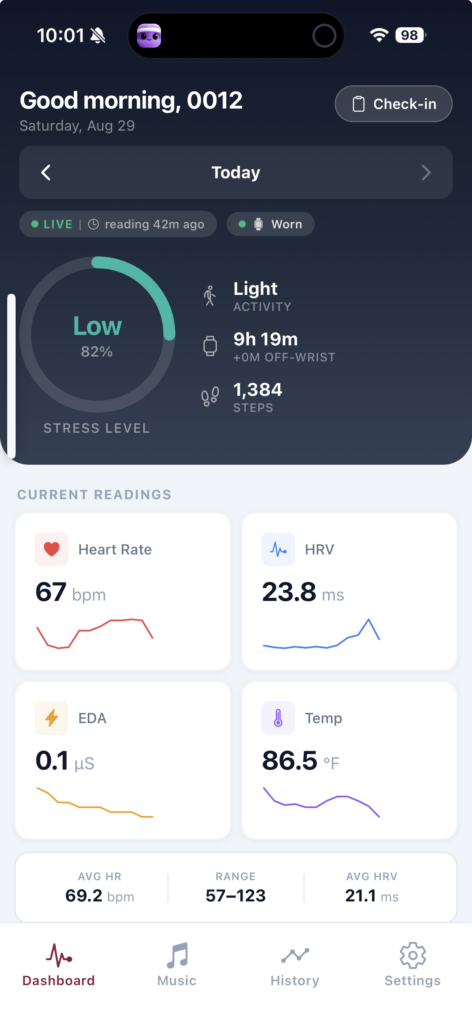
The first phase of the project included recruiting 30 people with AUD to wear wristbands for 14 days for at least 10 hours per day. The bands monitored heart rate, sweat production, and other stress biomarkers. If a participant felt stressed, they pushed a button on the band.
The research team, which includes scientists from WSU, Arizona State University, and the University of Southern California, used the biomarkers and the number of button pushes to develop an artificial intelligence model. They tested the model by going back and using it to predict when users would press the button. The AI matched up with 94% accuracy, significantly higher than the targeted 75%.
“That was really the most critical part of phase one, making sure that what the wristbands measure matches what people report as stress,” Cleveland said. “The AI modeling tool was very accurate in predicting when the button would be pushed.”
The volunteer participants, recruited in partnership with WSU’s Elson S. Floyd College of Medicine, also took part in short surveys four times each day, responding to questions about stressful situations.
Participants received a Spotify Premium subscription during the 14-day study and listened exclusively to songs on the music platform for that period. The researchers had access to all the songs each person listened to, including data on each song’s beats per minute, danceability, acoustic or electronic qualities, and loudness, and when they listened. Spotify normally uses these measures to recommend new music to listeners, but the researchers will use them in phase two of the study to test their newly developed app.
Now that phase one is completed the research team is analyzing what music was playing before, during, and after the buttons were pushed. Results are promising and reveal patterns in how some musical features changed in the 10 minutes before and after participants pressed the button. For example, before stress, people were more likely to listen to lower energy acoustic music less suitable for dancing.
This is the first real-world test of the relationship between stress and music, as all previous work has been done in lab environments, Cleveland said.
Phase one ended June 30 and the team exceeded all of its targets, so the NIH has approved phase two for three more years. That includes recruiting 30 different volunteer participants and the development of a smart phone app that will work with the wristbands. When the wristband detects stress markers rising, it will trigger a message to pop up on the user’s app asking if they are experiencing stress. If the answer is yes, then it will play a predetermined playlist.
“Each person will have developed three to five playlists, with the help of a music therapist and based on personal preferences, that can intervene to reduce stress,” Cleveland said. “The songs will step down in intensity following a period of stress, allowing people to reduce stress slowly. We’re planning around eights songs per playlist, with an option for participants to give a ‘thumbs up’ or ‘thumbs down’ to tell us if each song is helpful.”
The app will ask participants if they are stressed so that false positives, like strenuous exercise, don’t automatically start a playlist.
Cleveland views the wristband as complementary, rather than as a replacement for current AUD treatments or recovery programs.
“We see this as an add-on tool to help people maintain recovery and prevent negative situations,” Cleveland said. “It’s one more way to help people that isn’t too invasive and can supplement therapy programs.”