Sharp apparel: super-powered smart wearables that could save your life one day
New high-tech fabrics created by Washington State University apparel researcher Hang Liu are bringing us comfortably closer to smart wearables that monitor our health, protect us from danger, and connect us to our communities.
Unlike past designs that were stiff with wires or coated in un-washable sprays, the prototypes that Liu is perfecting can stretch, bend, and endure hundreds of washing machine cycles.
“We wear garments every day,” said Liu, associate professor in the Department of Apparel, Merchandising, Design, and Textiles. “Why not integrate functions instead of wearing accessories? We’re making that idea come true.”
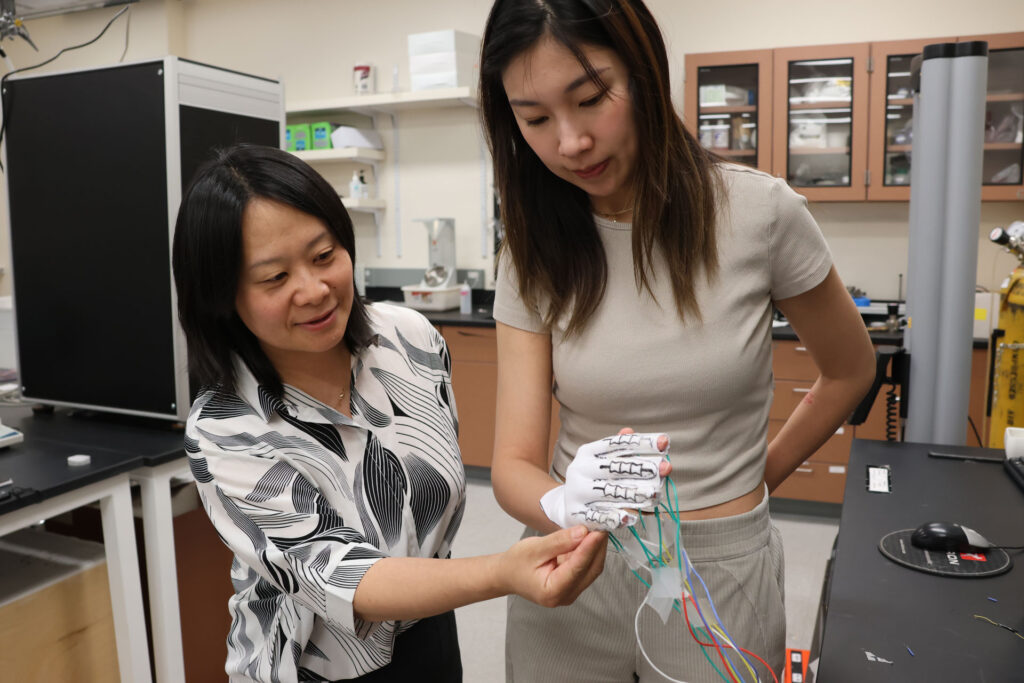
Smart wearables are clothing that integrate sensors and other technology to perform tasks or improve performance: think shirts that track a runner’s heart rate or firefighters’ jackets that can tell when the wearer is in danger.
For decades, such clothing was science fiction. But in the last few years, new materials and methods have helped scientists make the leap to reality.
Funded by the National Science Foundation and other partners, Liu is spinning electrically conductive fibers and 3D printing conductive polymers on cloth. One prototype in her lab, a glove covered with a web of stretchy polymers, is designed to help rural patients receive a remote exam on finger mobility. The glove itself is the sensor: as the wearer’s finger flexes, the signal from the printed polymer changes. Similar approaches could help rural doctors remotely diagnose heart conditions or automatically detect a medical emergency.
Future fabrics are Liu’s passion. As an undergraduate in China, she became fascinated with functional textiles after learning about nonwoven fabrics. Created directly from fibers without yarn processing, such fabrics use various bonding technologies and make strong-yet-disposable hospital dressings and gowns.
For her doctoral project, Liu developed absorbable antimicrobial surgical sutures, then came to WSU to experiment with functional textiles and nanofibers. So small they can’t be seen with the eye, nanofibers can provide advanced functions, such as electrical signal conduction. Liu’s electro-spinners lay down these fibers for “smart” fabrics that could be incorporated into clothing for a myriad of uses.
In her newest project, Liu is developing breathable hybrid fibers that can sense human vital signs and resist temperatures up to 400 degrees Fahrenheit without burning and losing functions.
“For those of us making advanced textiles, smart wearables are a very hot field,” she said. “There’s so much more we can do. The future’s not far away.”