Next-gen weather station upgrade empowers high school students, educators
This fall, scientists in the College of Agricultural, Human, and Natural Resource Sciences (CAHNRS) are joining forces with Washington high schools in a project that helps teens gain firsthand experience with weather-sensing technology.
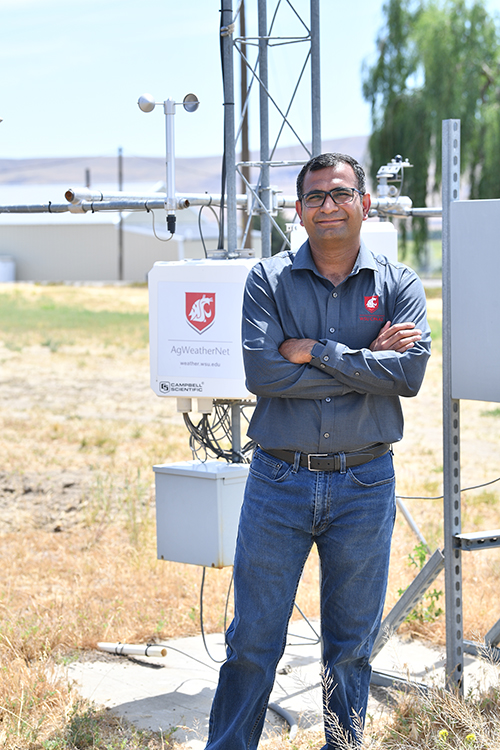
“We’re building the weather network of the future and the next generation of Washington’s workforce,” said Lav Khot, project leader and director of AgWeatherNet, Washington State University’s automated weather station network.
Funded by $1.5 million from the Washington State Department of Agriculture (WSDA), the project upgrades AgWeatherNet, a statewide system of more than 360 weather stations serving farmers and the public. It will also connect the system with educators and students in 15 Washington school districts.
Every 15 minutes, AgWeatherNet collects dozens of metrics, from air temperature, rainfall, and wind speed to humidity and leaf wetness. Shared online and through digital decision tools, this data helps growers know when to water, mitigate cold or heat stress, and manage pests and diseases.
The bulk of the network is made up of six-foot-tall legacy stations introduced in 2008, complemented by privately owned stations. Khot and his team of meteorologists have been working to upgrade older stations to new, 33-foot “Tier 1” towers with added capabilities. The funding allows them to add more than 35 new towers, bringing the statewide tally to 100 upgraded towers over the next two years.
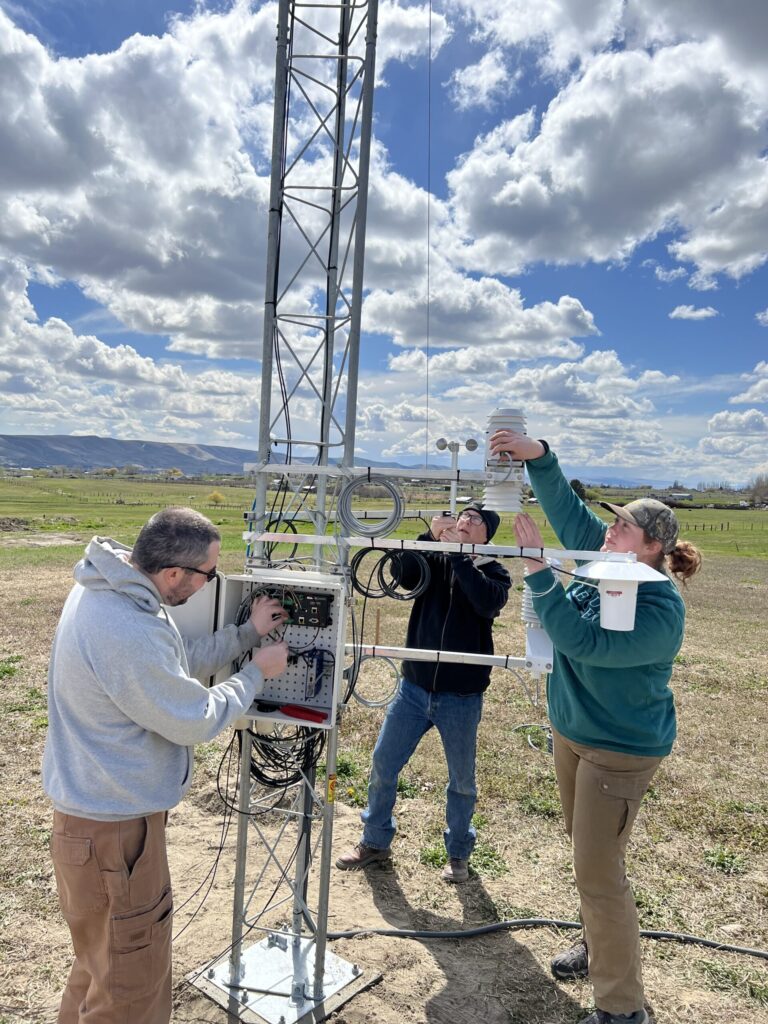
Fifteen high schools will receive new legacy stations on their grounds as part of the project, joining 10 high schools with existing AgWeatherNet stations. The WSU team is working with WSDA to identify school districts serving communities that face disproportionate environmental hazards. University educators will partner with high-school agriculture and science teachers and AgWeatherNet engineers to develop curriculum that helps students and teachers learn about, operate, and maintain the stations.
“We’re very excited to engage with teachers and students using AgWeatherNet technology, allowing them to explore air quality, drought, wildfire impacts, and other challenges,” said Nancy Deringer, associate dean of CAHNRS Student Success and Academic Programs. “This project gives students real-life, hands-on experiences and puts them at the controls of a modern weather station. They’ll be able to see how weather data is collected and learn how weather impacts crops grown where they live.”
The project, she added, is an excellent example of how WSU reaches out to communities and inspires student curiosity about future careers.
AgWeatherNet’s new Tier 1 towers measure weather more accurately over a wider scale, reaching out as far as 25 miles and allowing better forecasting of potentially damaging temperatures, winds, and storms.
Equipped with more sensitive equipment for measuring weather, wildfire pollution, and air quality, the taller towers are also better at detecting inversion, or atmospheric layers that are warmer than surface layers. Those improvements are key to helping growers manage adverse weather conditions that can cause severe crop loss in apples, cherries, grapes, and berries. Inversion detection will also assist with pesticide spray advisories, leading to better crop protection and reduced drift.
The project also adds four depth probes to collect soil moisture and temperature data at more than 220 stations, improving drought forecasting in Washington.
WSDA recently surveyed and interviewed more than 400 farmers on what they need to remain resilient.
“We overwhelmingly heard that growers want enhanced weather data, better climate projections, and more data-based decision-support tools,” said Dani Gelardi, WSDA senior soil scientist and climate coordinator. “These AgWeatherNet upgrades are an enormous step toward ensuring that Washington agriculture remains viable and vital through current and future challenges.”
Also benefiting cattle feeders, agricultural workers, and public agencies, AgWeatherNet logs hundreds of thousands of website visits annually.
“Thanks to WSDA, we can now inspire future generations of scientists, growers, and leaders as we establish tools for better monitoring,” Khot said. “Weather affects everyone, and the more we understand it, the more we can safeguard our economy, environment, and health. This work is an important step in that direction.”
Learn more about AgWeatherNet at weather.wsu.edu.