Coming to orchards: Sunflare™, WSU’s newest apple, brings great bite, eye-catching colors
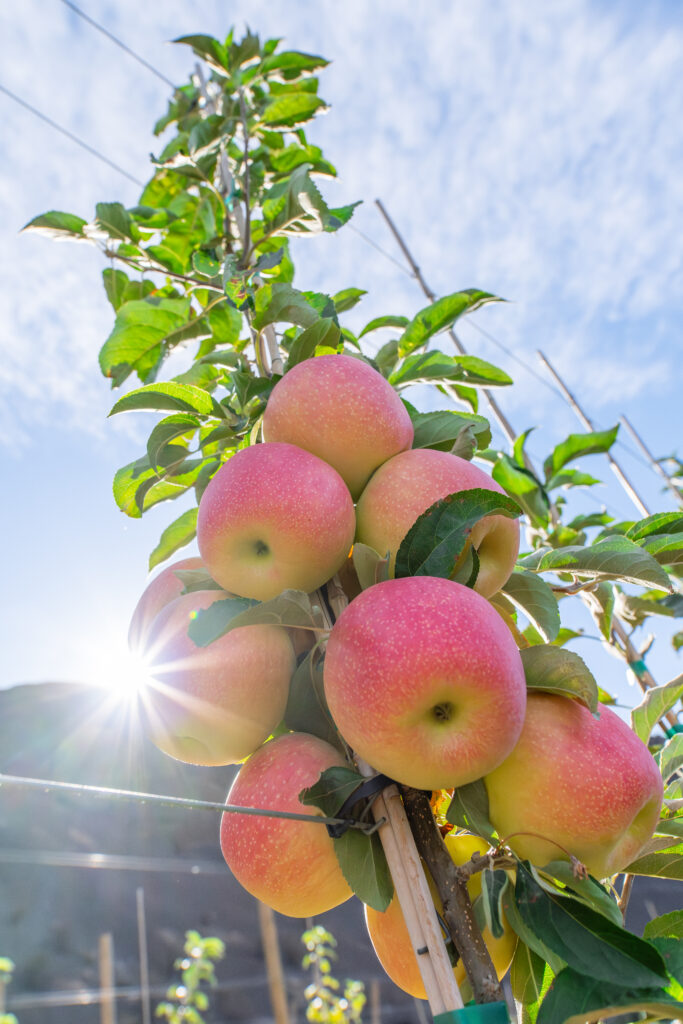
It’s sweet yet tart, crunchy, juicy, and named by a Washington apple lover for its eye-catching pink and yellow colors.
Meet Sunflare™, Washington State University’s new apple variety.
“Our breeding program exists to give consumers better apples to eat, and Sunflare™ checks all our boxes,” said Kate Evans, WSU professor and pome fruit breeder.
A hybrid of Honeycrisp and Cripps Pink — one of several cultivars sold as Pink Lady® — Sunflare™ combines a firm bite with a complex, balanced, sweet and tart-balanced flavor as well as outstanding storage qualities. It’s a bicolored apple, featuring an attractive pink blush over a yellow background when ripe.
Expected to reach consumers in 2029, this new variety was released as cultivar WA 64 in 2023. It’s the third apple to emerge from the WSU breeding program, which launched Cosmic Crisp® in 2019.
WSU scientists first bred Sunflare™ in 1998 when they hand-pollinated a Honeycrisp flower with pollen from a Cripps Pink tree at the Columbia View Research Orchard near Wenatchee, Washington.
“We do what the bees do,” said retired scientist Bruce Barritt, who launched the WSU apple breeding program in 1994. “Sunflare™ resulted from pollination. It’s not engineered or modified in any way.”
Contest-winning name
The new apple was named in a 2024 public contest that drew more than 15,000 responses. WSU sought a creative, distinctive name that consumers would remember and link positively with the fruit. Sunflare™ won in part by best reflecting the apple’s physical qualities.
“The name hits all those marks,” said Jeremy Tamsen, director of the WSU Office of Commercialization. “The pinks, oranges, and yellows stand out against all the red apples on the shelf.”
Winning contestant Ryan Escarcega, a 49-year-old food service salesperson and chef from Centralia, Washington, was inspired by the variety’s bright hues as well as the powerful solar storms that sparked northern lights across North American skies in spring 2024.
“I looked at the picture of the apple for a long time, fantasizing about what it was going to taste like,” he said. “It was a real eye-catcher. I saw a nice relationship between the colors and the name. And the sun has everything to do with the growth of the product.”
Introducing Sunflare™ to growers
Now that the apple has been released, WSU scientists are continuing to study it and share recommendations on the best ways to grow WA 64. They offer their latest findings at grower-attended field days, including two preharvest sessions this September at Rock Island and Prosser, Washington.
The university is also working with a Washington-based licensing partner, International New-Varieties Network LLC (INN) of Ephrata, Washington, to manage tree sales and make this new variety available to nurseries and growers. Some 23,000 WA 64 trees have been produced for delivery in spring 2026. WA 64 trees are available for backyard growers to purchase from licensed nurseries.
“We are still in the very early stages of the launch, but our goal is to get plantings in all growing areas of the state,” said Garry Langford, general manager of INN.
Royalties from sales of the trees, budwood, and, eventually, the fruit itself, will help support research and development of future apple varieties at WSU. Support for WA 64 breeding and development was provided by the Washington Tree Fruit Research Commission, the Washington State Department of Agriculture’s Specialty Crop Block Grant Program, the Washington Research Foundation, and WSU apple royalties.
Escarcega, who received a box of Sunflare™ apples and other WSU-themed prizes for his winning name, was one of the first consumers, beyond small groups of testers and field day participants, to taste the new apple.
“I am so excited to be part of this, and even happier that the only apple I will ever eat, as of 2029, will be the best tasting apple I have yet had the pleasure of eating,” he said. “I love it and its culinary possibilities.”