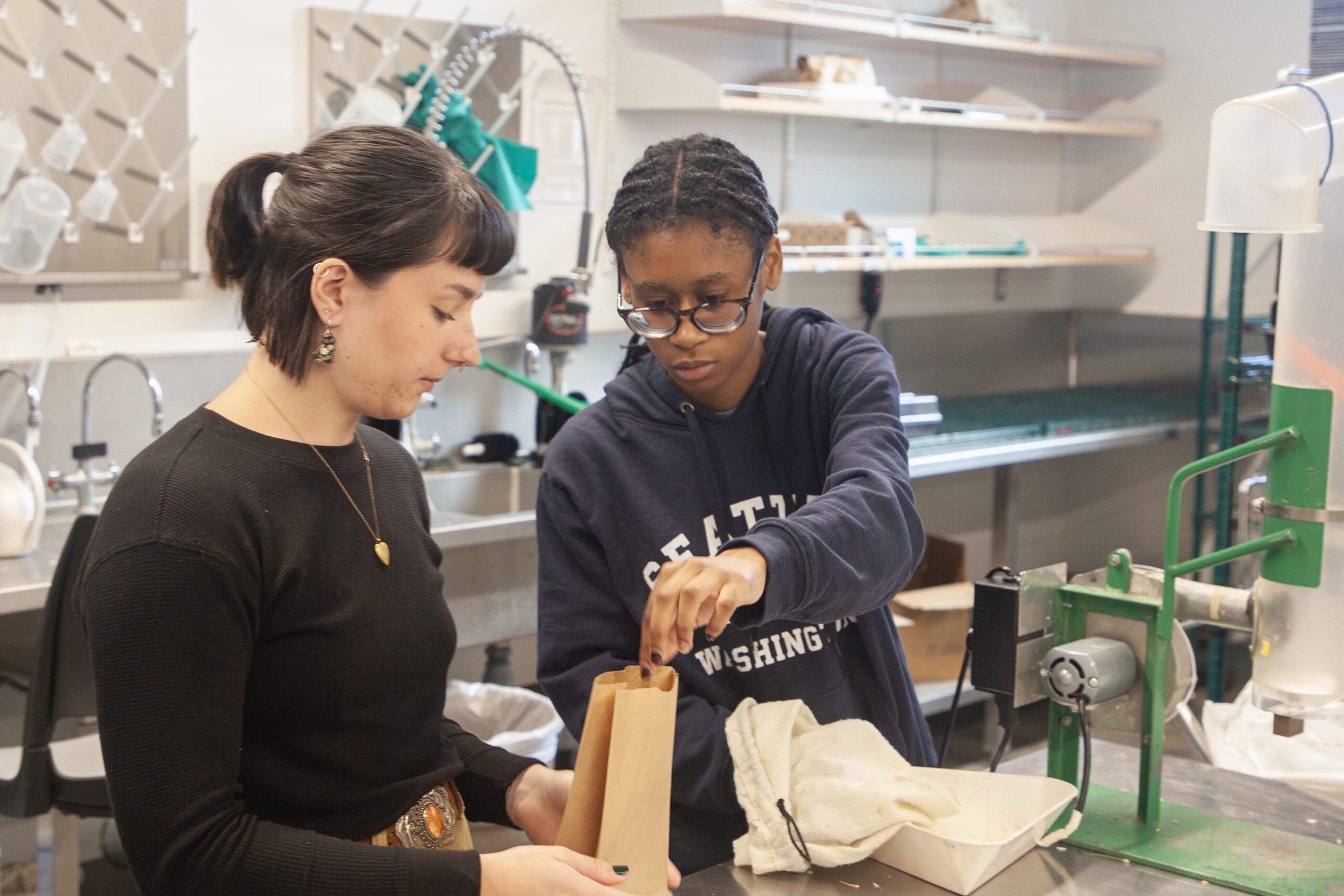
Hands-on science experience key focus of WSU summer internship program
Jakiyah Johnson is a Washington State University biology major and criminology minor with no experience in agriculture. But a love of science led her to look for internship opportunities that included hands-on research.
“I took an ecology class in spring 2024 semester and I really liked it,” said Johnson, a Dallas native who enrolled at WSU to pursue a career in forensics. “When I learned about WSU’s Research and Extension Experiences for Undergraduates (REEU) program, I thought it would be interesting. I’ve enjoyed it a lot.”
REEU is funded by a USDA National Institute of Food and Agriculture grant. The program’s primary goal is to provide undergraduate students with real-world research experience in agriculture over the course of nine weeks each summer.
“We want students to see and do basic science but also get exposure to Extension and the type of applied research that directly impacts growers,” said Andrei Smertenko, associate professor in WSU’s Institute of Biological Chemistry (IBC) who leads the REEU program. “The students work in labs, and they also visit farms to do soil tests and talk with farmers.”
2024 was year three of the five-year grant that supports 10 REEU students annually. Students are paid a stipend and have their housing covered for the program’s duration. REEU is also open to students outside WSU, a major selling point for program leaders.
“There are several predominantly undergraduate campuses that focus on teaching and don’t have significant research facilities,” said Smertenko. “We work closely with faculty at several institutions so they can talk about the program and encourage their students to apply.”
So far, REEU has attracted students from WSU, Central Washington University, Lewis-Clark State College, and Whitworth University, among other institutions.
“It’s so great working in these huge labs doing impactful research,” said Matt Cochran, a senior environmental science major at Whitworth. “I want to go to graduate school after I finish my degree, and having this hands-on experience confirms that. I really like data and statistics, so getting to work with this program is fantastic.”
At the end of the session, students present their research at a poster symposium on the WSU Pullman campus. That’s one of the program’s few requirements.
“All we want is for each student to learn something,” Smertenko said. “There are no strict targets or goals. The most important thing is that they leave the program with more experience than when they started. We try to teach them and provide experience in a relaxed and stress-free manner.”
He added that students seem to enjoy that the program isn’t concentrated on a single topic, something that is more common in research internships.
“We’re highly unfocused and encourage students to work on several projects in their short time here,” Smertenko said.
That’s part of what drew WSU senior landscape, nursery, and greenhouse management major Sophie LeBard to apply.
“I was interested in crop genetics, but I didn’t have any real experience,” said LeBard, a Vancouver, Wash., native. “I thought this would be a good way to see how interested I actually am in this kind of work. I wanted to know if I would enjoy research and maybe go on to graduate school. This experience has increased my interest quite a bit.”
That’s exactly what program organizers want to hear. To make it happen, they need buy-in from other WSU faculty who can teach some scientific basics.
“Part of our mission is training the next generation of scientists and leaders,” said Mark Lange, IBC director. “It’s the hands-on experiences that are most important in life. You can learn a lot from studying a book, but you’re more likely to retain something that you actually do. I’ve taught REEU students that had never worked with a plant and had no idea what we do in IBC. This kind of program can change lives.”
Smertenko and other program leaders are focused on continuous improvement of the student experience. Along those lines, they survey participants before and after their summer internships.
“We try to be uninhibited when making changes and trying new things,” said Matt Peck, a scholarly assistant professor in WSU’s College of Veterinary Medicine who has an REEU leadership role. “We keep what works and throw out what doesn’t.”
WSU’s REEU program will continue through 2026. After that, the USDA grant cannot be renewed, but Smertenko and his colleagues hope the program will become established so they can continue it with support from other funding sources.
“We’ve seen how much this is helping students learn about science and research,” Smertenko said. “We want to continue helping people who will advance science and improve society.”